Commercial Leasing & Advisory
13 Min Read
19 November 2026GCCs and Data Centres Are Redrawing Indian Real Estate Map
Share
Table of Contents+

TL;DR
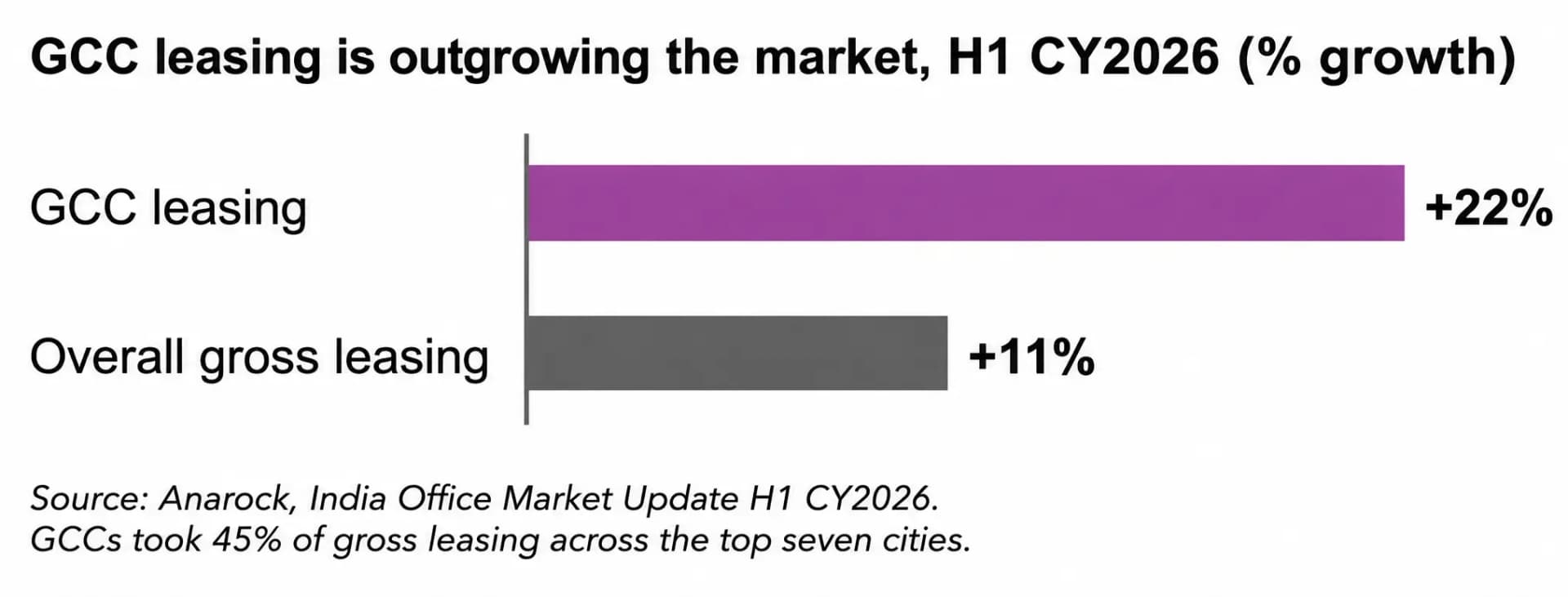
- GCCs took 45% of office leasing across the top seven cities in H1 CY2026, on 19.2 mn sq ft of gross take-up, up 22% against 11% for the overall market (Anarock, India Office Market Update H1 CY2026).
- Data centres run at about 1.8 GW of operational capacity, with a pipeline past 6.7 GW by 2030 and more than $300 bn of announced commitments behind it (Anarock data centre market study, August 2026).
- The two answer to different scarce inputs: a GCC goes where it can hire, a data centre where it can draw power and reach a subsea cable. Where their maps overlap they do so on separate parcels, so the shift adds demand rather than reshuffling it.
Introduction
For two decades, the logic of commercial real estate in India was simple: the occupier came to the real estate. An office tower rose near a central business district, a warehouse beside a highway or a port. That order has started to reverse, because two kinds of occupier now generate so much demand that developers build toward wherever each one can find the single input it cannot do without.
Those two occupiers are global capability centres (GCCs) and data centres. A GCC is the in-house offshore unit a multinational owns and runs with its own staff rather than a vendor. A data centre is the industrial-grade building that houses the servers a digital economy runs on. One has become the largest single force in the office market, the other the fastest-growing in the industrial one. Because each chases a different scarce input, the two pull the map of where real estate gets built in opposite directions at once.
In offices the shift has already happened; in industrial it is just beginning
The office market gives the clearest measure of how far this has gone. GCCs took 45% of all office leasing across the top seven cities in H1 CY2026. Gross take-up reached 19.2 mn sq ft, up 22% over the same half a year earlier (Anarock, India Office Market Update H1 CY2026). That demand is concentrated in large, long-term commitments, with deals above 0.1 mn sq ft making up 59% of leasing, and that anchor take-up is tightening the market: Grade A rent is at ₹96 per sq ft per month, up 9%, and vacancy has fallen to 15% from 16.3%.
The data centre side is earlier in the same curve, but moving faster. India crossed about 1.8 GW of operational capacity in the first half of 2026. The planned pipeline would carry that past 6.7 GW by 2030, behind more than $300 bn of announced commitments (Anarock data centre market study, The blueprint of the digital fortress in India, August 2026). Not all of that will be built on schedule, and the headline capital figure blends group-level and multi-year pledges rather than money committed today. Even read conservatively, both numbers describe a structural change in who the market builds for, which is what makes where they build worth following.
GCCs are pulling office development toward talent, not the old business districts
A GCC goes where it can hire, and that single fact has redrawn the office map more than any change in rent. Because the parent staffs the centre itself on a long Grade A lease, the headline rent is not what binds. The binding constraint is the depth of specialist talent a city can supply over a two-to-three-year hiring ramp. Development follows the graduates: office construction has deepened fastest in the cities with the largest engineering and finance talent pools, not the cheapest space.
That demand is widening even as it deepens. Bengaluru still takes the largest single share of GCC leasing, on the deepest talent base in the country. But GCC leasing in Hyderabad rose 68% in the half, and in the Mumbai Metropolitan Region (MMR) it nearly tripled. India already hosts more than 1,700 GCCs employing over 1.9 million professionals, a base set to pass 2,400 by 2030 (Anarock x FICCI, Workplaces 2025). Which city suits a given centre is a separate decision, set out in an Anarock view on which Indian city is best for a GCC. For the map, what matters is that demand now reaches more talent markets, pushing development into city peripheries and, for delivery-heavy work, into selected tier-2 and tier-3 cities. The office map is spreading along the lines where graduates are, not where the old business districts sit.
Data centres are pulling industrial development toward power and the coast
A data centre is built around a different set of constraints, and its map looks nothing like the office one. A campus needs 50 to 200 contiguous acres, a sanctioned high-voltage power connection that can take 12 to 24 months to secure, and a large, assured water supply for cooling. A workable site must supply all three before a single server is installed. The requirement screens out most land and pulls construction toward places an office or a warehouse would never have chosen.
The strongest pull is toward the coast. Mumbai and its metropolitan region hold about half of national operational capacity. With Chennai, the two coastal hubs account for roughly three-quarters of it (Anarock data centre market study, August 2026). The reason is latency, the delay data takes to travel. The subsea cables that carry international traffic come ashore at those hubs, and the latency-sensitive load stays close to where they land. Inland hubs such as Delhi-NCR, Hyderabad and Bengaluru serve enterprise and the computing that sits beside GCC demand. As Mumbai runs short of land and power, new supply is spilling onto state-allocated industrial land and into cities such as Ahmedabad and Visakhapatnam. The two are set to cross a combined 100 MW by the end of 2026. The industrial map is being drawn to a coastline and to allocated land, chosen for power and fibre rather than for proximity to anything a tenant used to value.
The two maps meet in a few cities, on entirely different site logic
Talent and power rarely point to the same place. The two maps overlap in only a handful of cities, and never for the same reason. Hyderabad, Delhi-NCR, Chennai and Bengaluru each carry both engines. But a GCC there wants Grade A office space near a talent catchment, while a data centre wants a large parcel of outer-ring industrial land with a sanctioned grid connection. The two rarely bid for the same plot: the engines share a city without competing for its land.
That is why the overlap adds demand rather than redistributing it. A city can win GCC campuses and data centre load at once, on different parcels. It can also win one engine and lose the other. A graduate-rich city may have no coastal cable landing; a power-rich coastal site may be thin on senior technology talent. The table sets the two engines side by side.
| GCC office demand | Data centre demand | |
|---|---|---|
| What it is | In-house offshore units multinationals own and run | Industrial-grade buildings that house computing |
| Headline demand, 2026 | 45% of top-seven office leasing; 19.2 mn sq ft, up 22% | About 1.8 GW operational; pipeline past 6.7 GW by 2030 |
| What decides the site | Depth of specialist talent and ready Grade A supply | Sanctioned power, subsea-cable latency, land and water |
| Where it concentrates | Bengaluru and Hyderabad, then MMR, Delhi-NCR, Pune, Chennai | Mumbai-MMR and Chennai, the coastal cable landings |
| Where demand is spilling | City peripheries and selected tier-2 hubs | Allocated industrial land and tier-2 cities such as Ahmedabad and Visakhapatnam |
| Demand profile | Campus-scale, long-tenure office leases | Infrastructure-grade, capital-heavy, long-life assets |
Behind each anchor, a second wave of demand follows
A GCC campus and a data centre each generate far more real estate demand than they occupy themselves. The GCC campus brings staff who need homes, retail and short-term flexible desks nearby. That demand shows up in the office market itself, where flexible space has risen to 25% of leasing from 22%. A data centre employs few people directly, but it anchors the power, fibre and logistics a digital economy needs and a long construction supply chain. This spillover into residential, retail, hospitality and logistics is traced in the Anarock half-yearly outlook on the growth trajectory and sectoral outlook for Indian real estate. Most of that downstream residential, retail and logistics space is eventually built on the land around a confirmed anchor, so a developer or a landowner weighs the surrounding ground as heavily as the anchor site.
For landowners and capital, the old proximity test has flipped
A landowner or an investor buying into this market now starts from a different first question than a decade ago. The test is no longer how close a site sits to a business district or an airport. It is which of the two engines a site can serve, and whether it can supply that engine's scarce input. For a GCC, that means a deep talent catchment and ready Grade A supply. For a data centre, it means a sanctioned power connection, a cable landing and clean-title industrial land. A parcel that fails both tests is worth less than its location once suggested; one that clears either is worth more.
The redraw is easy to overstate, and its limits are worth stating plainly. Both engines concentrate in the same handful of cities that already led the market. Much of the shift is a deepening of established hubs rather than a move to new ground, and the genuinely new corridors are still a small share of the total. In the mandates the commercial leasing and advisory team runs, the change is less that demand has left the old centres than that the same city is now underwritten twice, once for the talent it can supply and once for the power it can deliver. Capital is moving the same way. Private equity into Indian real estate rose 46% by deal count over the last financial year, with data centres among the fastest-growing categories for institutional money. That capital increasingly underwrites a site on the input it can supply, so the locations that can prove talent or power are the ones drawing investment through the cycle ahead.
Key takeaways
- GCC demand follows talent: it took 45% of top-seven office leasing in H1 CY2026 and is widening across more talent markets, into city peripheries and selected tier-2 cities.
- Data centre demand follows power and subsea cable: Mumbai-MMR and Chennai hold roughly three-quarters of operational capacity, with spillover onto allocated industrial land and tier-2 hubs.
- The redraw deepens established hubs as much as it opens new ones, so the shift for an owner is in how a site is screened, by the input it can supply rather than its distance to a business district.
Where this sits at Anarock
The commercial leasing and advisory team at Anarock runs city and site selection and Grade A transactions for global occupiers building GCCs, while the industrial and logistics advisory practice and the capital-markets desk handle the land, power and structuring behind data centre campuses. The half-yearly India Office Market Update is produced by the Anarock research desk under Dr Prashant Thakur, with the commercial leasing practice under Peush Jain, and the data centre market study by the research and advisory practice. For the two questions this piece sets aside, see the view on which city is best for a GCC and the account of how GCCs are reshaping commercial real estate demand; the diligence both asset classes demand runs through the role of data analytics in real estate decisions. One caveat is worth keeping: the data centre pipeline is announced capacity, not commissioned, and the private-equity deal-count figure is attributed to the last financial year because the exact period could not be independently dated.
Frequently asked questions
What is redrawing the commercial real estate map in India?
Two occupier classes: global capability centres (GCCs) and data centres. GCCs took 45% of top-seven office leasing in H1 CY2026, and data centres run about 1.8 GW of operational capacity with a pipeline past 6.7 GW by 2030. GCCs follow talent and data centres follow power and subsea cable, so development no longer follows the old logic of building near a central business district.
How much office demand do GCCs now drive in India?
GCCs took 45% of top-seven office leasing in H1 CY2026, on 19.2 mn sq ft of gross take-up, up 22% against 11% for the overall market, with deals above 0.1 mn sq ft making up 59% (Anarock, India Office Market Update H1 CY2026). India hosts more than 1,700 GCCs employing over 1.9 million professionals, projected to pass 2,400 by 2030.
Where are data centres being built in India, and why?
Mumbai and its metropolitan region hold about half of national operational data centre capacity, and with Chennai the two coastal hubs hold roughly three-quarters, because the subsea cables that carry international traffic land there and latency follows the distance to those landings. As Mumbai runs short of land and power, new supply is spilling onto state-allocated industrial land and into tier-2 cities such as Ahmedabad and Visakhapatnam (Anarock data centre market study, August 2026).
Do GCCs and data centres compete for the same sites?
GCCs and data centres rarely compete for the same site. In a city that carries both, a GCC wants Grade A office space near a talent catchment, while a data centre wants a large parcel of outer-ring industrial land with a sanctioned high-voltage power connection. Because the two seek different parcels, the overlap adds demand to a city rather than reshuffling it, and a city can win one engine while missing the other.
Are tier-2 cities part of this shift?
Tier-2 cities feature on both sides of the shift. For GCCs, delivery-heavy work is moving into selected tier-2 and tier-3 cities that offer lower rent and attrition, usually after a first centre is anchored in a metro for senior talent. For data centres, a second wave of cities such as Ahmedabad and Visakhapatnam is set to cross a combined 100 MW by the end of 2026 on the back of 5G rollout and data-localisation rules.
What does the shift mean for real estate investors and developers?
The first screen on a site is no longer its distance to a business district but which engine it can serve and whether it can supply that engine's scarce input: a deep talent catchment and ready Grade A supply for a GCC, or a sanctioned power connection, a cable landing and clean-title industrial land for a data centre. The redraw deepens established hubs as much as it opens new ones, so the change for an owner is mainly in how a site is screened.
Sources
- Anarock Research, India Office Market Update H1 CY2026 (July 2026); GCC share of leasing, gross take-up, large-deal share, Grade A rent, vacancy and flex share.
- Anarock Research & Advisory, The blueprint of the digital fortress in India (August 2026); operational and pipeline capacity, hub geography, site requirements and tier-2 expansion.
- Anarock Research & Advisory with CREDAI, Indian Real Estate: Growth Trajectory, Sectoral Outlook and Geopolitical Crosscurrents (October 2026); sectoral spillover, capital flows and the macro picture.
- Anarock x FICCI, Workplaces 2025: India Commercial Real Estate Reimagined (February 2026); India GCC count, employment and 2030 projection.
- Anarock, GCC India: which city is best for setting up a global capability centre; city-by-city view.