
13 Min Read
09 October 2026GCC India: which city is best for setting up a global capability centre?
Share
Table of Contents+

TL;DR
- GCCs took a record 45% of Grade A office leasing across the top seven cities in H1 CY2026, up from 41% a year earlier, on gross take-up of 19.2 mn sq ft, up 22% (Anarock, India Office Market Update H1 CY2026).
- Bengaluru is the clear first choice, with 39% of national GCC leasing and the deepest talent market in the country (Anarock, Bengaluru: Where Talent Meets Capital).
- Hyderabad is the decisive number two, its share now 16%, past MMR, the National Capital Region (NCR), Pune and Chennai (Anarock x FICCI, Hyderabad: The Rise of a Global Capability Powerhouse).
- The second tier reordered in one half-year: MMR rose fastest of all, nearly tripling, while NCR and Chennai contracted; each now serves a different mandate.
- The binding constraint is Grade A supply timing against a two-to-three-year hiring ramp, not rent: the cost edge in Hyderabad sits alongside the country's highest office vacancy, 23.5%.
Introduction
Not long ago, a global capability centre (GCC) in India was treated as a cost-saving offshore model. That has changed: it is now the largest driver of Grade A office leasing in the country. The clearest sign is in the numbers. In H1 CY2026, GCCs took a record 45% of all office leasing across the top seven cities, up from 41% a year earlier. Gross take-up reached 19.2 mn sq ft, up 22% (Anarock, India Office Market Update H1 CY2026). As it spreads from software into finance, engineering and life sciences, the location decision grows harder.
India is the default place to build one: it hosts more than 1,700 GCCs employing over 1.9 million professionals, projected to pass 2,400 by 2030 (Anarock x FICCI, Workplaces 2025). The question is no longer whether to build here but which city. On the same data our commercial leasing teams use to place these mandates, this is where each city leads, what it is best for, and what would reorder the field.
Why does the city decide the economics of a GCC?
With a captive, the economics are set by the city it sits in. GCC is an in-house offshore unit a multinational owns and runs, keeping talent and intellectual property in-house rather than with a vendor. Because the parent hires locally and signs long Grade A leases, the choice of city compounds over the years a centre runs.
Four levers set those economics, each a property of the city: the depth and cost of specialist talent for the functions hired, the availability and rent trajectory of Grade A space over the build-out, infrastructure and commute; and ecosystem density, the peer captives that de-risk hiring and supply.
Which Indian city is best for setting up a GCC?
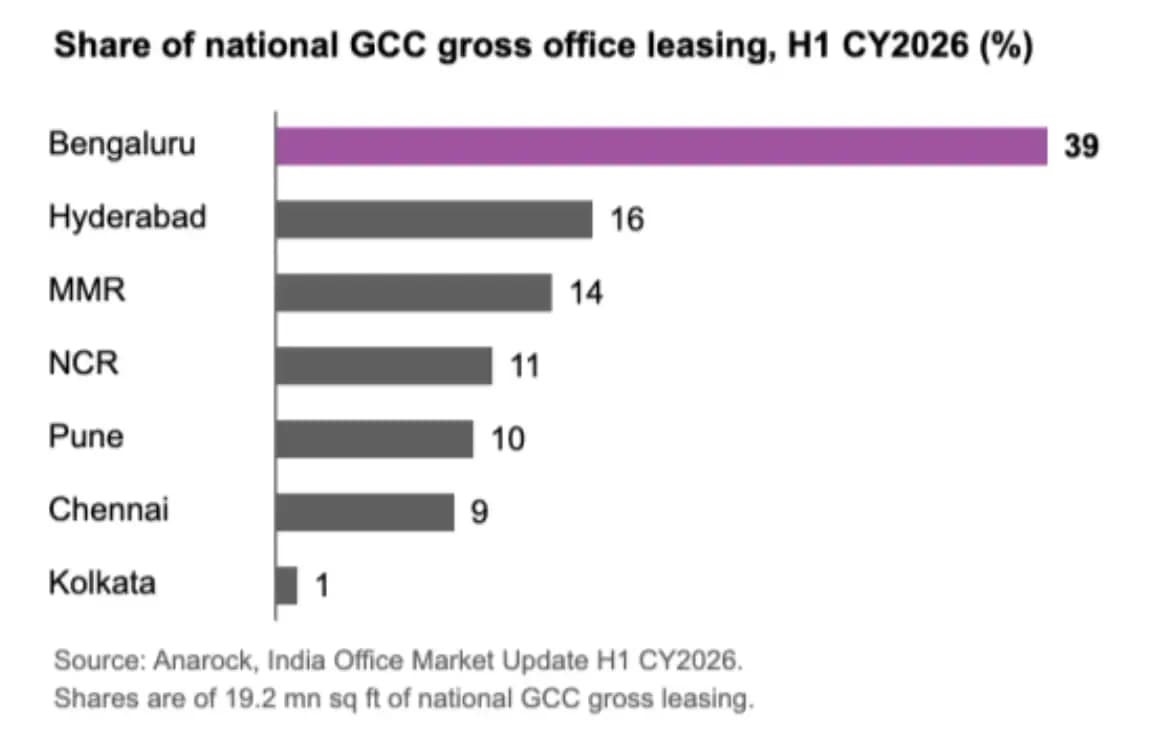
On those four levers, Bengaluru leads on almost every line, and the H1 CY2026 data only widens the gap. It took 39% of national GCC gross leasing, close to two and a half times the next city (India Office Market Update H1 CY2026). Beneath it, Hyderabad has moved into second and the rest into a cluster of specialists, each strong on a different lever.
| City | GCC leasing (mn sq ft) | Share of national GCC leasing | Net office absorption (mn sq ft) | Grade A vacancy | Avg Grade A rent (₹/sq ft/mo) | Best suited to |
|---|---|---|---|---|---|---|
| Bengaluru | 7.6 | 39% | 8.3 | 10.8% | 107 | Deep tech, product and R&D at scale |
| Hyderabad | 3.1 | 16% | 5.2 | 23.5% | 75 | Cost-efficient scale; banking, financial services and insurance (BFSI), engineering, life sciences |
| MMR | 2.7 | 14% | 4.3 | 13.5% | 154 | BFSI and capital-markets captives |
| NCR | 2.2 | 11% | 4.3 | 20.8% | 96 | BFSI and consulting; flex-led entry |
| Pune | 1.9 | 10% | 2.6 | 11.4% | 89 | Engineering R&D and manufacturing |
| Chennai | 1.75 | 9% | 2.4 | 8.6% | 82 | Automotive, engineering and BFSI |
| Kolkata | 0.15 | 1% | 0.5 | 16.9% | 66 | Early-stage, cost-led delivery |
| Top 7 | 19.2 | 100% | 27.4 | 15% | 96 | – |
Bengaluru sits far enough ahead that one half-year does not move it. Because these are one half-year's figures, the order beneath Bengaluru is best read as current momentum, not a settled ranking.
Why does Bengaluru still lead the GCC map?
Two decades of scale and depth explain the lead, first in talent. Bengaluru hosts more than 875 GCC units and over 665,000 GCC professionals, the largest such base in the country, per the Anarock report Bengaluru: Where Talent Meets Capital. That depth decides whether a plan to hire hundreds fills on schedule or competes for scarce talent.
The property market is as deep as the labour market. Bengaluru absorbed 8.3 mn sq ft of Grade A space in H1 CY2026, 30% of net absorption across the top seven cities and up 26% year on year (Anarock, India Office Market Update H1 CY2026). A roster of technology majors and global banks keeps the hiring ecosystem self-reinforcing, so Bengaluru stays the default first centre.
Bengaluru or Hyderabad: which fits a new GCC?
A first India centre comes down mainly to Bengaluru (Bangalore) and Hyderabad. GCC leasing in Hyderabad rose 68% to 3.1 mn sq ft, lifting its share to 16% and moving it past MMR, NCR, Pune and Chennai into a clear second (India Office Market Update H1 CY2026). The talent base has thickened just as fast: more than 515 GCCs and over 300,000 professionals, with more than 70 new centres added in FY25, the most anywhere (Anarock x FICCI, Hyderabad: The Rise of a Global Capability Powerhouse). Those counts use a broader basis than the cross-city unit count that ranks Bengaluru first.
| Metric | Bengaluru | Hyderabad |
|---|---|---|
| GCC leasing, H1 CY2026 | 7.6 mn sq ft | 3.1 mn sq ft |
| Share of national GCC leasing, H1 CY2026 | 39% | 16% |
| Net office absorption, H1 CY2026 | 8.3 mn sq ft (up 26%) | 5.2 mn sq ft (up 24%) |
| Grade A vacancy | 10.8% | 23.5% |
| Average Grade A rent | ₹107/sq ft/mo | ₹75/sq ft/mo |
| National rank by GCC leasing | 1st | 2nd |
The trade is talent depth against cost and headroom. Bengaluru offers the deepest, most-proven pool, but at a 30% rent premium in a near-full market. Hyderabad offers rent roughly 30% lower, large floor plates in HITEC City, Gachibowli and the Financial District, and a base diversifying into BFSI, engineering, semiconductors and life sciences. Its 23.5% vacancy cuts both ways: it hands a tenant negotiating leverage but is also the highest unfilled stock in the country, a sign supply has run ahead of take-up. For a corporate real-estate head choosing between the two, a centre that must hire scarce senior talent fast points to Bengaluru; a cost-led scale mandate favours Hyderabad.
How do MMR, NCR, Pune and Chennai compare for a GCC?
Below Bengaluru and Hyderabad sit four markets, and the right one depends less on size than on the mandate, as their leasing mix shows.
- MR rose fastest of all, GCC leasing nearly tripling to 2.7 mn sq ft for a 14% share, though BFSI still anchors that demand at 43% of leasing. The costliest market on the list, it holds that premium with capital-markets and banking captives that put proximity to headquarters and regulators above rent.
- NCR went the other way, its GCC leasing down 23% to 2.2 mn sq ft as flex operators, now 40% of leasing, took up demand that once arrived as direct captive deals. The pool for BFSI and consulting stays deep; what needs planning around is the tilt to flex and a still-high vacancy.
- Pune barely moved, holding about 1.9 mn sq ft and a 10% share, its mix leaning to engineering, R&D and manufacturing. It is the cost-effective engineering base for captives stepping beyond pure software.
- Chennai runs the tightest market in the country, vacancy at 8.6%, even as GCC leasing pulled back 37% to 1.75 mn sq ft off a strong prior year. Automotive, engineering and BFSI mandates that want a stable base fit here, provided the occupier accepts that scarce space caps how fast it can scale.
None competes with Bengaluru on scale or Hyderabad on momentum; each is a specialism in its own right.
What does a GCC pay for office space across Indian cities?
Specialism decides the shortlist, but cost decides between close options, and rent is the number occupiers compare first. Average Grade A rent ranges from ₹66/sq ft/month in Kolkata to ₹154 in MMR, against a pan-India ₹96 (Anarock, India Office Market Update H1 CY2026). Within a city the range is wider still: in Bengaluru the central business district commands ₹130-240/sq ft/month against ₹40-70 in Electronic City, so the micro-market often matters as much as the city.
Set against global benchmarks, the choice of Indian city barely moves the cost case: prime Grade A rents across India run at roughly $1-2 per sq ft per month, well below the United States, the United Kingdom, Singapore and Australia (Nasscom, cited in the Anarock report Why U.S. Retailers Are Turning to India for Next-Generation GCCs). Next to talent, rent is a small share of the total cost.
Are Tier-2 cities a viable location for a GCC?
Cost also points past the metros. For delivery-heavy work that hires at volume, a Tier-2 hub offers lower rent and lower attrition, but it lacks the senior-leadership pool and ready Grade A supply a first captive needs.
The usual answer is to anchor a first centre in a metro for leadership, then add a Tier-2 delivery centre once the operating model is proven. Sequencing the build this way keeps blended cost down without putting the early phase at risk.
What is the outlook for GCC-led office demand?
Sequencing only pays off if demand lasts, and the H1 CY2026 data indicates it will. GCC leasing grew 22% in the half against 11% for overall gross leasing, taking a growing share of an expanding market, and should stay the central force through 2026 and into 2027 (Anarock, India Office Market Update H1 CY2026). The constraint that most often resets a shortlist is the timing of Grade A supply against a two-to-three-year hiring ramp, with net absorption running ahead of completions.
On present momentum, Hyderabad and MMR should keep gaining national share, while the scale of Bengaluru keeps it the largest beneficiary. For occupiers planning headcount to 2028, the decision is timing more than today's ranking: what matters is where Grade A supply will be ready, city by city.
Key takeaways
- Bengaluru is the default first centre, with 39% of national GCC leasing and the deepest talent market, the safe pick when hiring must move fast.
- Hyderabad is the strongest challenger, rent roughly 30% lower and a 16% national share; the risk is the country's highest office vacancy, 23.5%.
- The second tier is a set of specialists: MMR for BFSI and capital markets, Pune for engineering and manufacturing, Chennai for automotive and low-vacancy stability, NCR for BFSI and flex-led entry.
- Rent decides less than talent: even the costliest Indian market is cheap globally at $1-2 per sq ft, so talent and supply timing outweigh rent.
- The binding constraint is Grade A supply timing against a two-to-three-year hiring ramp, so decide on where ready supply will be over the build-out.
Where this sits at Anarock
The commercial leasing and advisory team at Anarock runs city selection, portfolio strategy and Grade A transactions for global occupiers building captives in India, on the same data behind this analysis. For the wider context, see how GCCs and data centres are redrawing the real estate map in India, and on a site decision, the factors to weigh when leasing office space.
Frequently asked questions
Which Indian city is best for setting up a GCC?
Bengaluru. It took 39% of national GCC gross office leasing in H1 CY2026, close to two and a half times the next city, and hosts more than 875 GCC units and over 665,000 GCC professionals, per Anarock. Its combination of the country's deepest talent pool and Grade A office market makes it the default location for a first captive, before cost or growth trade-offs are considered.
Is Bengaluru or Hyderabad better for a new GCC?
It depends on the mandate. Bengaluru (Bangalore) offers the largest, most-proven hiring pool and is the safer choice when a captive must fill senior technology and product roles quickly. Hyderabad offers rent roughly 30% lower, large efficient floor plates and rapid growth, with GCC leasing up 68% and a 16% national share in H1 CY2026, which suits cost-led scale mandates in BFSI, engineering and life sciences. The offset in Hyderabad is the highest office vacancy nationally at 23.5% (Anarock, India Office Market Update H1 CY2026).
What is a global capability centre (GCC)?
A GCC is an in-house offshore centre that a multinational owns and operates to deliver engineering, product, analytics, finance and shared-services work for its global business. Unlike third-party outsourcing, the parent keeps the talent, intellectual property and roadmap in-house, which is why the location decision carries long-term hiring and capital consequences.
How much does office space cost for a GCC across Indian cities?
Average Grade A rent ranged from ₹66/sq ft/month in Kolkata and ₹75 in Hyderabad to ₹154 in MMR in H1 CY2026, against a pan-India average of ₹96, with Bengaluru at ₹107 (Anarock, India Office Market Update H1 CY2026). In global terms even the costliest Indian market is inexpensive, with prime rents around $1-2 per sq ft per month. The full cost of building and running a captive is dominated by talent, not rent, and should be sized separately.
Which Indian cities are growing fastest for GCCs?
Hyderabad and MMR posted the sharpest GCC growth in H1 CY2026: leasing in Hyderabad rose 68% to 3.1 mn sq ft and its national share reached 16%, while GCC leasing in MMR nearly tripled to 2.7 mn sq ft and its share reached 14%. NCR and Chennai contracted over the same half, per Anarock.
How big is the GCC market in India?
India hosts more than 1,700 GCCs employing over 1.9 million professionals, a base projected to exceed 2,400 centres by 2030 (Anarock x FICCI, Workplaces 2025). Measured by value the market grew from about $30 billion in 2019 to roughly $64 billion in 2024 and is projected to reach $105-110 billion by 2030 at around a 10% CAGR.
Are Tier-2 cities viable for a GCC?
Yes, for the right functions. Tier-2 hubs offer lower rent and lower attrition, which suits delivery-heavy and process functions, but they carry thinner senior-leadership pools and shallower Grade A supply. The common model is to anchor a first centre in a metro for leadership and hiring depth, then add a Tier-2 delivery centre once the operating model is proven.
Sources
- Anarock Research, India Office Market Update H1 CY2026 (published July 2026); national and city GCC leasing, net absorption, vacancy and rent.
- Anarock Research & Advisory, Bengaluru: Where Talent Meets Capital – Residential & Office Market Insights (April 2026); GCC units, talent base and full-year 2025 GCC leasing share.
- Anarock x FICCI, Hyderabad: The Rise of a Global Capability Powerhouse (September 2026); Hyderabad GCC base, additions and office snapshot.
- Anarock x FICCI, Workplaces 2025: India Commercial Real Estate Reimagined (February 2026); India GCC market size and count.
- Anarock, Why U.S. Retailers Are Turning to India for Next-Generation GCCs (February 2026); global rent benchmark (Nasscom).