
9 Min Read
03 November 2026Office space leasing vs buying: why the hold period decides the answer
Share
Table of Contents+
TL;DR
- The choice is a capital decision before a property one: leasing keeps capital compounding in the business as a predictable operating cost, while buying converts it into a hard asset and fixes the occupancy cost.
- Leasing is dearer but space is available. Grade A rent rose 9% to ₹96 per sq ft per month in H1 CY2026 while vacancy eased to 15%, so occupiers keep real choice in most markets (Anarock, India Office Market Update H1 CY2026).
- Ownership is separable from occupation: a listed REIT pays 5.1-6.0% on office income, and a sale-and-leaseback frees trapped capital while the company stays in place.
Introduction
Deciding whether to lease or own an office in India used to be a question a company could leave until after it had found the space. Space was abundant, landlords competed on terms, and the choice rarely reached the finance team as a capital decision. That has changed, because the market has tightened. Across the top seven cities in H1 CY2026, net absorption, the space newly taken up, ran 5.2 mn sq ft ahead of completions, vacancy eased to 15% from 16.3%, and average Grade A rent, the newest institutionally owned office stock, rose 9% to ₹96 per sq ft per month (India Office Market Update, H1 CY2026). As the market tightens, both the rent a tenant signs and the price of the same floor rise, so the lease-or-own call now moves more capital than when space was cheap.
So the lease-or-own question is now a capital-allocation question, set by two prices: what leasing costs today, and what owning the same space would take off the table. What follows prices both paths, against the market set out in the 2026 office outlook.
What it costs to lease Grade A office space now
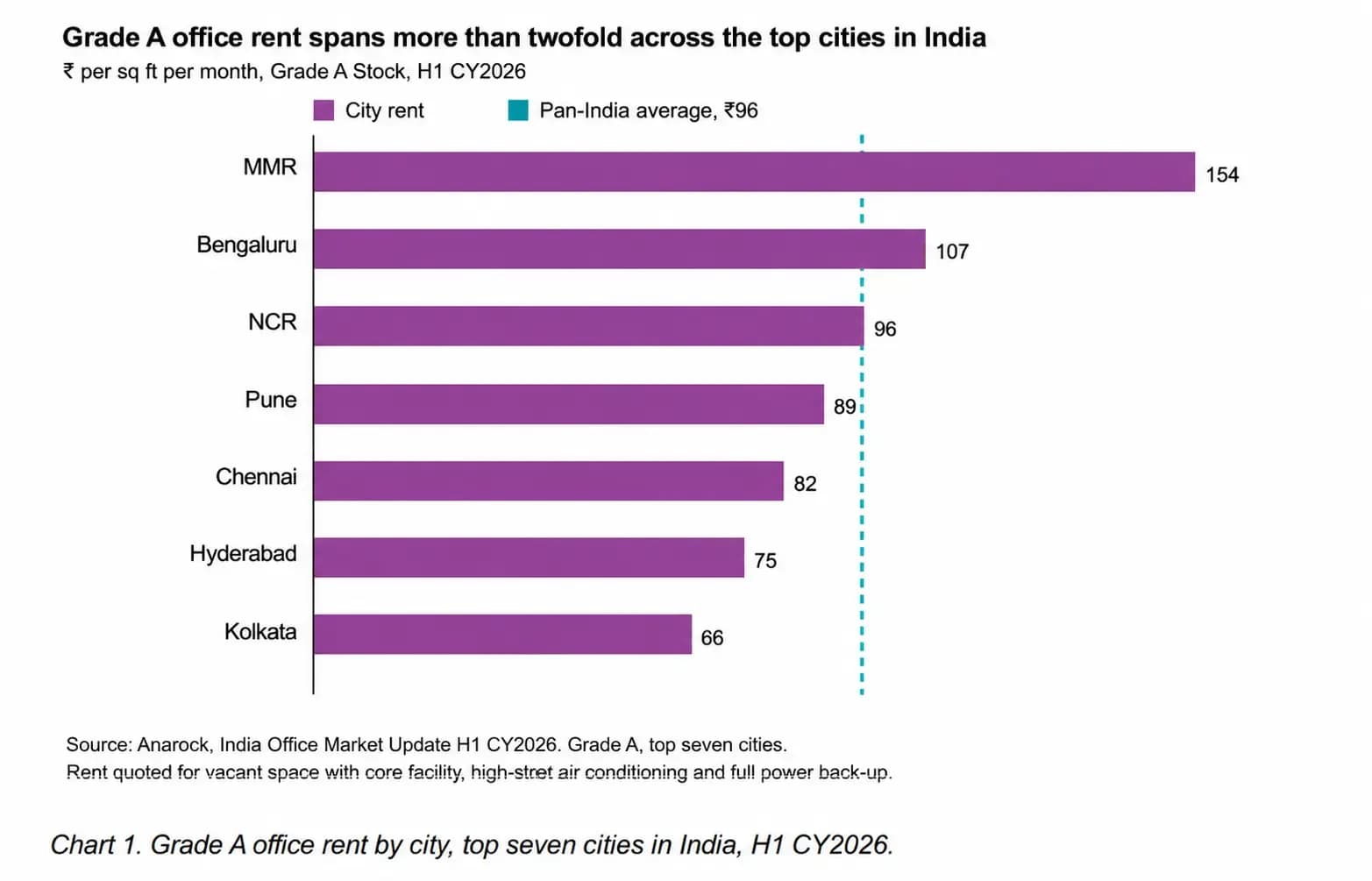
A lease turns occupancy into a monthly cost, and that cost has been climbing. Pan-India Grade A rent reached ₹96 per sq ft per month in H1 CY2026, up 9% in a year and nearly 30% above the 2021 base (India Office Market Update, H1 CY2026). The headline is narrower than it looks: Anarock quotes it for vacant space with a core facility, high-side air conditioning and full power back-up, so anything beyond that shell lands in the tenant budget.
City spreads are wide, and they set where a tenant holds pricing power. MMR is the costliest market at ₹154 per sq ft per month, Bengaluru follows at ₹107, and Kolkata is the cheapest at ₹66. Vacancy is the counterweight. For an occupier, it sets the leverage in a negotiation: where vacancy runs high, as in Hyderabad at 23.5% or NCR at 20.8%, a tenant can press for rent-free build-out time, capped escalations and shorter lock-ins, while Chennai at 8.6% leaves little room to bargain.
| City | Avg Grade A rent (₹/sq ft/month) | Vacancy | Occupier read |
|---|---|---|---|
| MMR | 154 | 13.5% | Costliest market; leverage only in softer micro-markets |
| Bengaluru | 107 | 10.8% | Deep demand from global centres; limited slack in prime areas |
| NCR | 96 | 20.8% | High vacancy; room to negotiate in many sub-markets |
| Pune | 89 | 11.4% | Tightening after heavy supply; broadly balanced |
| Chennai | 82 | 8.6% | Tightest market; pricing power sits with landlords |
| Hyderabad | 75 | 23.5% | Highest vacancy; strongest tenant leverage |
| Kolkata | 66 | 16.9% | Most affordable; thin, if recovering, demand |
Headline rent is only the start. A tenant also funds a refundable deposit of six to twelve months, common-area maintenance (CAM) charges and the fit-out, the interior build-out that turns bare space into a working office; leases then escalate about 15% every three years, so the rent signed is not the rent paid in year five. The governing clauses sit in the Anarock reads on the key clauses in a commercial lease and the factors in leasing office space.
Rent, though, is only half the comparison. The other half is the capital that owning the same floor locks up, and that number begins with the yield a buyer will accept.
When ownership earns its place
Ownership pays where capital is cheap and the building is one the company means to keep. The clearest case is a strategic, effectively permanent site, such as a headquarters or a large global-capability campus held for a decade or more, where the cost of the tied-up capital is small and renewal risk disappears. For occupiers weighing a long hold, money locked into a floor is money not compounding elsewhere, so a low cost of capital strengthens the case.
Supply-tight markets reinforce the case: where vacancy is low, as in Chennai at 8.6% or the prime pockets of Bengaluru, landlords hold the pricing power and future renewals carry real cost, so owning removes an escalating liability and hands over a depreciation shield that can later be refinanced or sold. Those conditions, though, describe a minority of occupiers; the majority sit in the opposite position.
Why leasing stays the default
Most occupiers are growing, or unsure how much space they will need, which is exactly where a lease is worth more than a title deed. The current market makes the point: with vacancy at 15% and net absorption running 5.2 mn sq ft ahead of completions, quality space is available without committing capital. Flexible-space operators now take 25% of leasing, up from 22% a year earlier, so a company can hand the build-out and term risk to an operator and pay a seat rate.
Scale demand is concentrating in the occupiers whose plans move most. Deals above 0.1 mn sq ft made up 59% of leasing in H1 CY2026, and global capability centres lifted their share of gross leasing to 45%. A lease lets such a tenant expand, contract or relocate as headcount changes, and a purchase would lock that flexibility away in a single building. Even so, lease and buy are not the only two options.
Owning office economics without owning the building
A company can hold the income and the upside of office property without ever buying a floor. A real estate investment trust (REIT), a listed trust that holds income-producing property, gives exposure to institutional-grade office income at a distribution yield of 5.1-6.0%, on CRISIL AAA balance sheets and without single-asset concentration (Indian REITs: Taking a Stride, Q2 FY26). For a corporate treasury that wants real-estate returns rather than a specific building, it is the cleanest route of all.
Two more structures split the difference. A sale-and-leaseback lets an owner-occupier sell a building it already holds and lease it straight back, releasing trapped capital while staying in occupation. A built-to-suit development, or a long lease with a purchase option, gives control of a specific asset without the full day-one outlay. Ownership and occupation are separable, then, so the question is not lease against buy but how much capital the business wants tied to the floor it works from, and in what form.
Key takeaways
The lease-or-own call turns on city- and building-level numbers, not a rule of thumb: rent and vacancy set leverage, the cap rate and hold decide whether owning pays. Arithmetic, market and accounting point the same way for most companies, with a clear set of exceptions.
- Buy where the hold is long, the cost of capital is low and the site is strategic, or where a supply-tight market such as Chennai removes renewal risk; lease where the footprint is growing or uncertain, which is most of the market.
- Remember that ownership is separable from occupation: a REIT at 5.1-6.0% or a sale-and-leaseback delivers office economics without the building.
Where this sits at Anarock
The commercial leasing and advisory practice advises occupiers on options analysis, benchmarking and negotiation on both paths, drawing on the data behind this piece. For the market this decision sits in, see the Anarock reads on the H1 CY2026 office market and on choosing the right long-term location.
Frequently asked questions
Is it better to lease or buy office space in India?
Leasing is the better choice for most companies, because it keeps capital compounding in the core business while quality space stays available; Grade A rent averaged ₹96 per sq ft per month in H1 CY2026 at 15% vacancy. Buying makes sense mainly for long-hold strategic sites, a low cost of capital, or supply-tight markets such as Chennai.
How much does Grade A office space cost to lease in India now?
Pan-India Grade A rent reached ₹96 per sq ft per month in H1 CY2026, up 9% in a year, with city spreads from ₹154 in MMR to ₹66 in Kolkata (Anarock India Office Market Update). Budget also for a six to twelve month deposit, common-area maintenance charges, a build-out, and escalation of about 15% every three years.
What cap rate should an occupier assume when buying office space in India?
Anarock Capital reports an office exit cap rate of 7.5-8.5% as of 30 September 2025. The cap rate is the yield a buyer prices the income at, so it is the input that decides what a rent-producing floor is worth to an owner, before stamp duty and registration of 5-7%.
When does buying office space make sense for a company?
Buying makes sense for a strategic, effectively permanent site held for a decade or more, such as a headquarters or a large global-capability campus, where the opportunity cost of tied-up capital is small. It also fits a low cost of capital, or supply-tight markets such as Chennai at 8.6% vacancy, where owning removes future renewal risk.
Can a company get office-ownership returns without buying a building?
Yes. A listed REIT offers institutional-grade office income at a distribution yield of 5.1-6.0% on CRISIL AAA balance sheets without single-asset risk, and a sale-and-leaseback releases capital from a building already owned while the company stays in occupation; a built-to-suit or long-lease-with-option structure blends the two.
Sources
- Anarock Research, India Office Market Update, H1 CY2026, top seven cities, Grade A, data to 30 June 2026 - rent, vacancy, absorption, city spreads and the rent definition used throughout.
- Anarock Capital, Indian REITs: Taking a Stride - Building Momentum with Scale & Performance (Q2 FY26 Newsletter Edition), data as of 30 September 2025 - office exit cap rate of 7.5-8.5% and REIT distribution yields of 5.1-6.0%.
- Anarock, Commercial real estate in India: the 2026 office market outlook - the wider market context for the lease-or-own decision.