
15 Min Read
19 October 2026Data centre investment in India 2026: what the capacity build actually requires
Share
Table of Contents+

Introduction
For most of the past decade, a data centre in India was a back-office utility, a secure shed of servers that concerned the IT team and no one on the investment committee. That has changed.
Private equity, pension funds and global platform investors now underwrite data centres directly, and the question they ask has moved from whether the demand is real to what the build actually requires.
The shift is not speculative. The country generates more data each year, artificial intelligence (AI) has pushed the power drawn by a single server rack to ten or twenty times its old level, and a 2023 data-protection law now requires large categories of personal data to be held on Indian soil.
Those forces have drawn more than $300 bn of announced capital and a pipeline that, on paper, roughly quadruples capacity by 2030. The gap between what is announced and what is running is made of constraints an investor must price one layer at a time
Announced capacity and commissioned capacity are not the same number
Only a fraction of that pipeline is drawing power today. India had about 1.8 GW of operational data centre capacity across 164 live facilities in the first half of 2026.
The route to a projected 6.7 GW by 2030 runs through a further 4.9 GW of planned capacity, and only 40-50% of that pipeline is under construction today. The rest is approved but not started, at roughly 30-35%, or merely announced, at 20-25%. Most of that approved and announced capacity is still several years from drawing power.
The announced investment figure carries the same distinction. The headline of more than $300 bn blends group-level and multi-year commitments. One conglomerate's pledge of $100 bn runs to 2035, and another's $110 bn is a seven-year compute plan.
The Anarock data centre market study, The blueprint of the digital fortress in India, cautions that these figures are group totals that should not be summed, because only a fraction of each is campus capex. The number describes a decade of intent, far ahead of money actually committed to buildings.
The figure that matters to an underwriter, the investor who has to price the risk, is the share of the pipeline that has cleared the constraints that turn an announcement into commissioned load. The investor who prices the announced number at face value is paying for capacity that may be years away.
Power decides the timeline before the land is bought
A grid connection is the longest-lead item on the whole build, and it is the one input capital cannot simply buy its way past. A campus needs a high-tension supply from a 33 kV, 66 kV or 132 kV substation within two to three kilometres, sanctioned before construction.
The connection takes 12-24 months, so the application to the distribution utility is filed on day one, and on a large campus up to 24 months before groundbreaking. The transformers alone carry a 12-18 month import lead.
In the mandates Anarock Investment Banking advises on, the gating item is rarely the equity cheque. It is a sanctioned connection and a clean, contiguous title. Without a bankable power agreement, the site is a land bank and nothing more.
Power also dominates the economics on both sides of the ledger. It is the single largest line in construction, at ₹14-22 crore per MW. Once the facility is live, electricity becomes the main driver of net operating income, running to 40-50% of operating cost.
Policy works to offset that cost. Infrastructure status gives data centres priority-sector lending at 9.5-10.5% over 12-year tenors, about 200 basis points below standard commercial real estate debt. A long-term renewable power purchase agreement fixes both the cost and the green credentials that hyperscale tenants now demand.
The pressure is only rising. An artificial-intelligence rack draws 30-60 kW against 8-10 kW for a conventional one, so the AI-ready capacity that carries a three-to-five-times revenue premium is also the capacity hardest to power. Because the power connection is the item most likely to slip, it is where diligence has to start.
Land and water quietly screen the shortlist
Acreage looks like the simplest line in the model, until a developer prices both the land a campus sits on and the water it consumes. A facility of 100-500 MW needs 50-200 contiguous acres.
Land cost swings from ₹35-60 crore per acre in the suburbs of Mumbai to ₹3-10 crore per acre on state-allocated industrial land. That is why operators chase parcels in designated zones, and why securing 30-50% more land than the first phase needs is itself treated as a value driver.
Water is the quieter constraint.
Cooling towers consume about 25.5 mn litres per MW each year, so a coastal site with assured supply has a structural advantage. An inland developer must model a full water balance before the site can be underwritten at all.
Flood and seismic risk screen the map before cost does. Flood exposure rules out sites on 100-year flood plains, a live concern on monsoon-season coastal land. Seismic risk rules out the highest-hazard zones, which the study flags as the Himalayan belt and Gujarat.
That creates a genuine tension. The coastal, renewable-rich geography that attracts the largest campuses can sit in higher-seismic zones, which means the best sites are won by engineering for the hazard and pricing it in.
Cooling technology then follows the workload, with direct liquid cooling now the emerging standard for dense AI builds because it holds power-usage effectiveness near 1.1-1.2. Between them, land, water and hazard screen out most sites before price enters.
Why the map clusters on two coastlines
The sites that survive those screens are not scattered. Most of the computing India runs on sits within reach of a handful of undersea cables. Mumbai and its metropolitan region hold about half of national operational capacity, at 812 MW, and Chennai holds a further 298 MW.
Together the two account for roughly three-quarters of the operational total, because both are landing points for the subsea cable systems, including 2Africa and India-Asia-Xpress, that are being laid through 2028. Latency is a function of distance to those cables, so the hubs that hold the landings also hold the latency-sensitive demand.
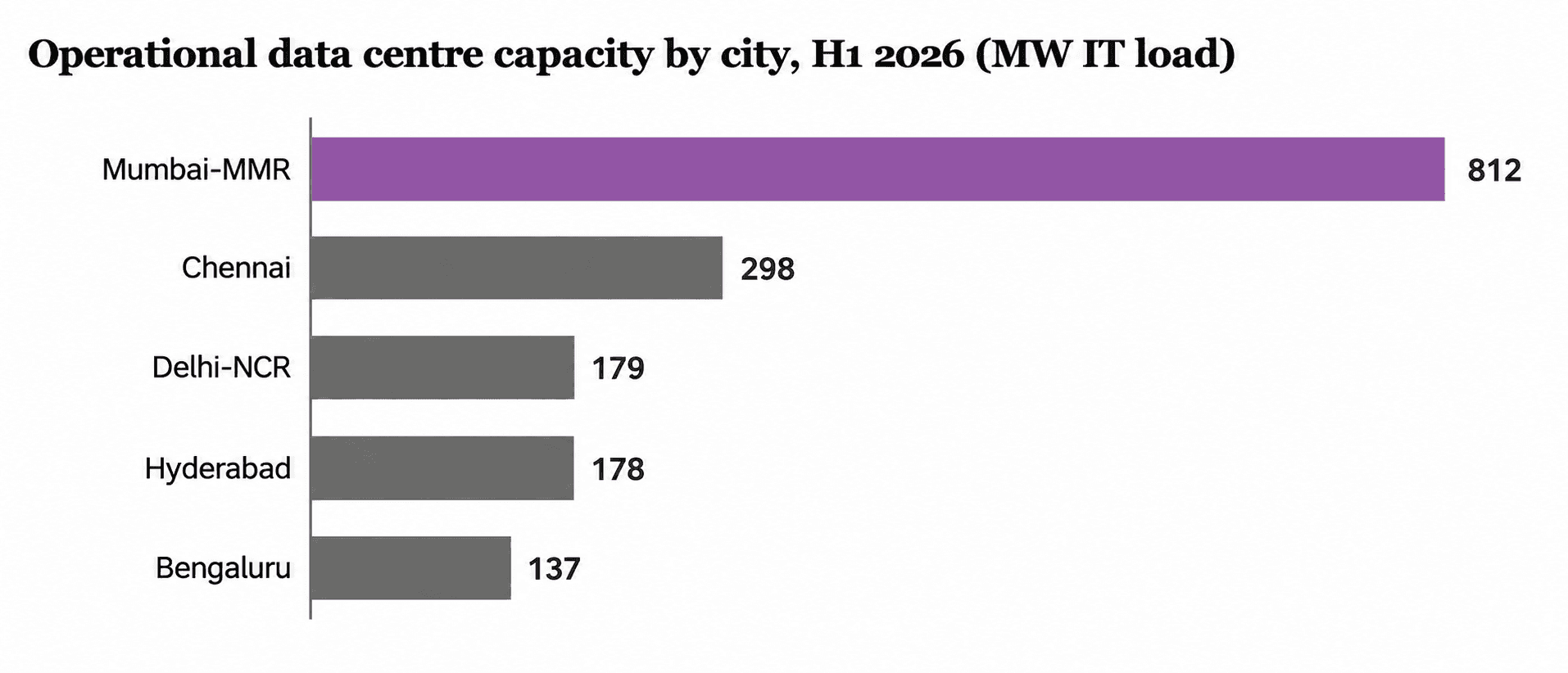
The inland hubs play a different role. Delhi-NCR, Hyderabad and Bengaluru serve enterprise, banking and the global-capability-centre demand that now clusters beside data centres across the same cities. All three carry large forward pipelines to 2030.
Mumbai, the largest hub, is running out of the room the inland cities still have. It is now so land- and power-constrained that new supply is going vertical and spilling into the Navi Mumbai periphery around Dombivli and Taloja.
A second wave of tier-II cities, among them Ahmedabad and Visakhapatnam, is set to cross a combined 100 MW by the end of 2026 on the back of 5G rollout and the data-localisation rule. That widens the investable map beyond the two coastlines, while the latency-sensitive demand stays where the cables land.
| Hub | Operational IT load, H1 2026 | Projected, 2030 | What the market clears |
|---|---|---|---|
| Mumbai-MMR | 812 MW | 1,950 MW | Subsea cable landings; deepest operator base; land and power now tight |
| Chennai | 298 MW | 900 MW | Coastal cable landings; state industrial land; strong power availability |
| Delhi-NCR | 179 MW | 550 MW | Northern enterprise and banking demand; large allocated parcels |
| Hyderabad | 178 MW | 800 MW | Low seismic risk; Outer Ring Road land banks; pro-investment policy |
| Bengaluru | 137 MW | 400 MW | GCC and enterprise demand; preferred disaster-recovery location |
What the cost per megawatt does to the underwriting
A site that clears power, land, water and a cable landing is only half the decision. The other half is what a megawatt of capacity there costs to build and run.
A finished campus is roughly three-quarters equipment and one-quarter building. That split, 75-80% of cost in power, cooling and IT infrastructure and only 20-25% in the real estate, is what separates this asset from any lease underwritten before.
The return accrues to whoever controls the scarce inputs, not to whoever owns the shell.
A greenfield tier-III campus, a reliability grade that can be maintained without going offline, costs ₹40-70 crore per MW to build, about $4.8-8.4 mn, and more on coastal, liquid-cooled AI builds.
The market study models a representative 30 MW tier-III campus in Navi Mumbai to show how that cost converts into a return. The value of the exercise is that it is explicit about every assumption.
| Line | Figure |
|---|---|
| All-in build cost | ₹78.4 crore per MW (~$8.3 mn), trimmed to ₹71–74 crore after state incentives |
| Funding | 70:30 debt-to-equity; debt at 9.5–10.5% over 12 years |
| Build and ramp | 30-month construction; revenue from month 31 |
| Stabilised revenue (year 5) | ₹402 crore at 93% utilisation; 48% EBITDA margin |
| Target return | 20–25% IRR at 2.5–3.5x over a 5–7 year hold |
Two things sit outside that model.
The first is import exposure. Because so much of the cost is imported equipment, the capex line moves with the rupee and with shipping, and 2026 pressed on both.
The currency weakened about 9%, and the electrical and cooling component of construction cost rose about 10% after the West Asia war. A campus budgeted in 2025 can therefore cost materially more to finish in 2026.
The second is the valuation gap. Indian assets trade at about $10-15 mn per MW against $20-30 mn in the United States and Singapore, a discount that exists because the market is young, illiquid and thin on listed comparables.
As institutional ownership deepens and a listed exit route opens, the discount should narrow, handing the early owner a re-rating on top of the operating yield.
How institutional capital takes the exposure
A data centre is not underwritten the way an office floor is. The exposure comes in four forms, each with a different risk-return slot:
- Platform equity - a stake in an operating company, which buys a portfolio and a management team in one move.
- Development joint venture - co-developing campuses, which shares construction and leasing risk for a development premium.
- Long-lease ownership - holding a stabilised asset let to a hyperscaler, which behaves like core-plus infrastructure (largely stable income with modest added risk), with cash flows that are contracted and often dollar-linked.
- Infrastructure debt - lending against those cash flows, made cheaper by the sector's infrastructure status.
For a core-plus mandate, the long lease fits; a higher-return mandate takes the development joint venture or the platform stake.
The exit route is the question still open.
India has no listed pure-play data centre REIT yet. The handful of listed real estate investment trusts in the country hold office and retail space, so institutional exposure today is private.
As leases season, a dedicated data centre REIT or an infrastructure investment trust is the plausible next route, and a trade sale to a global platform is the other. That is why a representative hold is modelled with a dual-track exit around year five.
Capital is already rotating this way: private equity into Indian real estate rose 46% by deal count last financial year, with data centres among the fastest-growing categories for institutional money.
For an investor, then, the binding constraint is not demand but execution against the power, land, water and capital stack. That is what will separate the campuses that get built and let from the gigawatts that are only ever announced.
Key takeaways
- Operational capacity, at 1.8 GW, is roughly a quarter of the 6.7 GW pipeline; read the pipeline as intent, not as inventory, and discount the share that has not broken ground.
- Power is the longest-lead and largest-cost input; the timeline is set by a sanctioned grid connection, and the power contract drives net operating income.
- Land and water pre-screen sites: a large campus needs 50-200 contiguous acres and about 25.5 mn litres per MW each year of cooling water, which favours allocated industrial land and the coast.
- Two coastal hubs, Mumbai-MMR and Chennai, hold roughly three-quarters of operational capacity, because the subsea cables land there and latency follows the cable.
- The asset is three-quarters equipment: capex runs ₹40-70 crore per MW, is exposed to the rupee and imports, and the return depends on how well an owner clears the constraint stack.
Where this sits at Anarock
Data centres underwrite as industrial-grade infrastructure, and the work that decides a return - securing a power connection, aggregating clean-title land, structuring the development and the lease - is the remit of the industrial and logistics advisory practice at Anarock and its capital-markets desk.
The figures here draw on two first-party Anarock reports from 2026: the data centre market study of August 2026, covering the five hubs and a representative campus, and the half-yearly growth and geopolitical outlook of October 2026, for the macro and construction-cost picture. One caveat is worth keeping: the representative campus economics are a published illustration, not a live transaction. For where occupier demand is concentrating, see the view on choosing a GCC city, and the diligence this asset demands runs through the role of data analytics in real estate decisions.
Frequently asked questions
How much data centre capacity does India have in 2026?
India crossed about 1.8 GW of operational data centre IT capacity across 164 live facilities in the first half of 2026, after adding a record 440 MW in 2025 and roughly 500 MW more expected in 2026. The projected pipeline would take capacity past 6.7 GW by 2030, backed by more than $300 bn of announced commitments, per the Anarock data centre market study.
Why is announced data centre capacity different from commissioned capacity?
Announced capacity counts projects that have not yet drawn power. Of the 4.9 GW of planned capacity that would take India to 6.7 GW by 2030, only 40-50% is under construction; the balance is approved but not started, at 30-35%, or merely announced, at 20-25%. The announced-investment headline is similar: the $300 bn-plus figure is made of group and multi-year commitments, not capital committed to campuses today.
What power does a data centre need, and how long does a connection take in India?
A campus needs a high-tension supply from a 33 kV, 66 kV or 132 kV substation within two to three kilometres, sanctioned before construction. The connection takes 12-24 months, so the application is filed on day one, and on a large campus up to 24 months before groundbreaking. Power is also the largest build cost, at ₹14-22 crore per MW, and 40-50% of annual operating cost.
How much land and water does a hyperscale data centre need?
A facility of 100-500 MW typically needs 50-200 contiguous acres, and developers usually acquire 30-50% more than the first phase requires for expansion. Cooling towers consume about 25.5 mn litres per MW each year, which gives coastal sites with assured water supply a structural advantage and obliges inland sites to model a full water balance before underwriting.
Which Indian cities lead data centre capacity, and why?
Mumbai and its metropolitan region lead with 812 MW of operational capacity, about half the national total, followed by Chennai at 298 MW; together they hold roughly three-quarters of operational capacity because the subsea cables land there. Delhi-NCR, Hyderabad and Bengaluru follow, serving enterprise and global-capability-centre demand, with large pipelines to 2030.
How much does it cost to build a data centre in India?
A greenfield tier-III campus costs ₹40-70 crore per MW, or about $4.8-8.4 mn, with roughly 75-80% of that in power, cooling and IT infrastructure and only 20-25% in the real estate. A representative 30 MW Navi Mumbai campus modelled by Anarock comes to ₹78.4 crore per MW all-in, trimmed to ₹71-74 crore after state incentives. Imported equipment leaves the cost exposed to the rupee.
What returns do Indian data centre assets offer?
A representative tier-III campus modelled by Anarock targets a 20-25% IRR at 2.5-3.5x over a 5-7 year hold, with a stabilised EBITDA margin near 48%. On top of the operating yield, Indian assets trade at about $10-15 mn per MW against $20-30 mn in the United States and Singapore, so the thesis adds a re-rating as the market institutionalises. These are illustrative figures, not a live-deal guarantee.
Is there a listed data centre REIT in India?
Not yet as a pure play. The listed real estate investment trusts in India hold office and retail assets, so institutional exposure to data centres today is private, through platform equity, development joint ventures, long-lease ownership or infrastructure debt. As leases season, a dedicated data centre REIT or an infrastructure investment trust is the plausible next route, alongside a trade sale to a global platform.
Sources
- Anarock Research & Advisory, "The blueprint of the digital fortress in India" (August 2026) - live report page
- Anarock Research & Advisory with CREDAI, "Indian Real Estate: Growth Trajectory, Sectoral Outlook and Geopolitical Crosscurrents" (October 2026) - live report page