HVS Anarock - Hospitality
7 Min Read
23 July 2026The Rise of Faith-led Hospitality in India
Share
Table of Contents+
Introduction
Religious and spiritual tourism is no longer just a volume story; it is becoming one of the most commercially significant travel segments globally, and likewise in India as well. Industry reports project the global religious tourism market to grow at a CAGR of over 15% between 2025 and 2030, projected to reach USD 671.9 billion by 2030, reflecting how faith-based travel is increasingly intersecting with heritage, culture, and branded hospitality.
India is one of the strongest examples of this shift. With an estimated 4.5 billion domestic tourist visits in 2025 and pilgrimage embedded within a large share of this movement, the country already has the demand base that many global religious tourism markets are trying to build. Maha Kumbh 2025, which drew over 66 crore devotees over 45 days, reinforced the scale of this opportunity. For hospitality, the question is no longer whether faith-based travel offers sufficient depth, but how the sector can capture the growing opportunity for premiumization. Rising traveller aspirations are creating demand for higher-quality accommodation, experience and service standards—forming a strong foundation for the entry and expansion of branded hotel supply.
The scale of the opportunity
This gap between recurring travel demand and formal hospitality supply is where the opportunity becomes most visible. Religious destinations have often had large visitor volumes but limited branded hospitality participation, with demand being absorbed by guesthouses, budget lodges, unorganised & unbranded hotels, dharmshalas, and family-run accommodations. That equation is now beginning to shift. At present, religious and spiritual destinations account for only about 6% of India’s existing branded hotel keys, with approximately 13,100 keys across 190 properties, compared to India’s total branded inventory of around 214,900 keys across 2,400 properties. This is a modest share for a segment that supports some of the highest travel volumes in the country.
The development pipeline, however, tells a more interesting story. Religious and spiritual destinations account for nearly 14% of India’s branded hotel pipeline by keys, translating to about 19,760 keys across 190 properties by 2030. In other words, the share of religious destinations in future supply is likely to rise to more than double its current share, a clear signal that hotel companies and developers are reassessing faith-led markets, not merely as volume-driven budget destinations, but as long-term branded hospitality opportunities.
What's driving the shift?
This shift is being supported by three converging forces. First, infrastructure has improved meaningfully across several pilgrimage centers. The PRASHAD scheme has sanctioned 48 projects across 27 states and union territories, focusing on pilgrimage infrastructure such as tourist facilitation centers, parking, ghats, lighting, sanitation, accessibility, safety, and visitor amenities. The momentum has strengthened further with the Union Budget 2025-26 announcing the development of India’s top 50 tourist destinations in
partnership with states through a challenge-mode approach, aimed at improving destination infrastructure, connectivity, and visitor experience. Separately, the Government of India has approved 40 projects across 23 states under the Special Assistance to States for Capital Investment scheme for developing iconic tourist centres to global Standards. This is important for hospitality because improved access, public amenities, and destination management can help convert pilgrimage footfalls into longer stays, higher spending, and stronger investor confidence.
Second, the profile of the religious traveller is changing. Pilgrimage is no longer limited to low-spend, short-duration travel. Families are combining temple visits with other tourism offerings such as leisure, wellness, cultural experiences, and short breaks. Younger travellers are also engaging with spiritual destinations through festivals, heritage circuits, yoga and meditation, and other curated experiences. This creates demand beyond a basic room, including quality F&B, clean and safe accommodation with reliable service standards, family rooms, banquet spaces, as well as senior-friendly designs, and transport support.
Third, several religious destinations are becoming part of broader economic and urban transformation stories. Ayodhya is the most visible example. The city moved from a largely unbranded, under-supplied pilgrimage market to one of India’s most active hospitality development destinations after the Ram Temple consecration. According to a recent article on Invest UP, the official promotional and facilitation agency of the Government of Uttar Pradesh, Ayodhya recorded 57.5 million visitors in 2023, crossed 160 million visitors in 2024, and saw more than 230 million devotees in the first six months of 2025. It is also estimated that Ayodhya’s tourism economy could touch INR 18,000 crore by 2028.
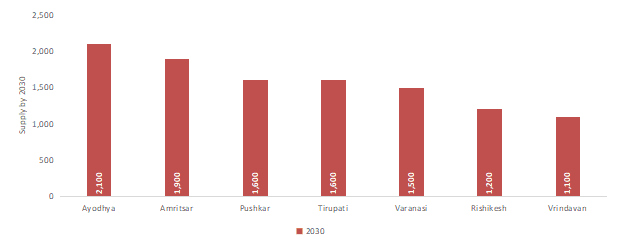
This helps explain why Ayodhya leads the religious destination pipeline with around 2,100 branded keys expected by 2030. It is followed by Amritsar, Pushkar, Tirupati, Varanasi, Rishikesh and Vrindavan. Ujjain, Haridwar and Dwarka are also emerging as active development markets. The pattern is important. These are not all identical destinations. Some are temple towns, some are riverfront spiritual centers, some are Sikh pilgrimage hubs, some combine faith with wellness, and some are evolving into leisure-spiritual hybrids. For brands, this means the opportunity is not restricted to one hotel positioning. Instead, it spans multiple segments, from economy and midscale hotels catering to high-volume pilgrimage demand to upscale and luxury offerings in destinations that increasingly combine faith with leisure, wellness, destination weddings, heritage, and cultural experiences.
Some of the major religious markets have already shown that religious demand can support branded hotels. Amritsar, for instance, benefits not only from the Golden Temple but also from border tourism, food, heritage, shopping, and a strong domestic and diaspora travel base. Varanasi has similarly moved beyond a purely pilgrimage-driven identity, with the Kashi Vishwanath Corridor, riverfront experience, cultural tourism, cruises, and improved urban infrastructure strengthening its broader appeal. Varanasi drew a record 72.6 million tourists in 2025, according to the Uttar Pradesh government. These examples suggest that successful branded hotel development in faith destinations depends not only on pilgrimage demand, but also on strong connectivity, complementary tourism drivers, and sustained destination investment.
The operator landscape also points to a maturing market. Several companies that already have a strong foothold in religious destinations are continuing to expand, which suggests that these markets are not being treated as one-off opportunities, but as repeatable hospitality plays with long-term demand visibility. While existing operators are expanding their presence, new entrants are beginning to view these destinations as credible branded hospitality opportunities rather than purely unorganised, budget-led accommodation hubs.
The way forward
The next phase of growth will depend on how sensitively these destinations are developed. Pilgrimage markets are high-volume but also high-pressure. They face sharp seasonality, crowd surges, traffic stress, carrying capacity constraints, sanitation challenges, cultural sensitivities, and the need to preserve local culture and sacred character. Hotel development in these locations cannot simply replicate urban commercial models; it needs to respond to family group sizes, elderly travelers, early check-ins, vegetarian F&B demand, proximity to shrine routes, parking needs, festival compression, and local community integration.
This is where the hospitality opportunity becomes more nuanced. Religious tourism not only creates room-night demand but can anchor entire local economies. A successful pilgrimage destination supports local businesses across segments and small entrepreneurs. Hotels can play a larger role in formalising this ecosystem by improving service quality, creating employment, supporting local sources, and encouraging longer stays.
The opportunity, therefore, goes beyond adding more rooms in religious destinations. These markets already have footfalls; the next phase of growth lies in creating organised hospitality infrastructure that can support longer stays, better service standards, and a more complete destination experience. However, hospitality infrastructure cannot develop in isolation. It must be supported by a wider tourism ecosystem, including cultural experiences, local shopping, food trails, festivals, interpretation centers, guided circuits, and well-managed public spaces. As access improves and traveller expectations evolve, pilgrimage-led destinations will need both tourism infrastructure and hospitality infrastructure to grow together, enabling them to move from high-volume accommodation markets to more structured and experienced hospitality ecosystems.
For India’s hotel sector, religious and spiritual tourism has the potential to become one of the most important demand frontiers of the next decade. Realising this opportunity will require close collaboration between hotel operators, developers, local communities, and government agencies to ensure that hospitality development progresses alongside infrastructure creation, destination management, crowd planning, and conservation. Ultimately, the opportunity lies not in commercialising faith, but in enriching the journey around it, making travel safer, cleaner, more comfortable, and more inclusive while preserving the sanctity and cultural depth that make these destinations so powerful and meaningful.