
14 Min Read
23 October 2026REIT vs InvIT in India: which structure suits an institutional portfolio
Share
Table of Contents+

TL;DR
- Both are listed trusts regulated by the Securities and Exchange Board of India (SEBI) that must pay out at least 90% of distributable cash, but a REIT owns rent-yielding property and an InvIT owns infrastructure such as roads, power lines and fibre.
- A REIT yields 5.1-6.0% with rental growth as leases reset, while an InvIT pays more up front, part of which can be a return of capital over a finite concession.
- A REIT is capped at 49% of asset value, while an InvIT can borrow up to 70% with an AAA rating, a six-distribution record and unitholder approval.
- Six REITs trade in India, reclassified as equity in 2025, while of 27 registered InvITs only a handful are publicly listed, so most InvIT exposure is privately placed.
- A REIT suits an allocator wanting liquid exposure to office rent; an InvIT suits a long-horizon holder wanting contracted income and duration.
- A single stabilised building under ₹500 crore points to a small and medium REIT (SM REIT), while a value-add or control position points to a direct or private hold.
Introduction
For most of the past decade, owning a slice of commercial real estate or infrastructure in India meant buying the asset outright, or backing the private owner who did. Today, an investor can own either one as a listed trust, priced on an exchange like any share. Two structures make that possible - the real estate investment trust (REIT) and the infrastructure investment trust (InvIT) - and large institutions increasingly hold both. The question has moved from whether these vehicles are investable to which one fits the asset an owner holds, the income a portfolio needs, and the risk it can carry.
The listed market has expanded on both sides of that question: six REITs now trade in India, with a combined market capitalisation of ₹2.08 lakh crore, and registered InvITs have climbed from four in FY19 to 27 by FY25 (Powering the Next Decade, May 2026). Many investors still treat the two as one income product. They are not interchangeable, and that difference is a decision, not a detail.
A shared wrapper, a different engine
Strip out the asset inside, and a REIT and an InvIT look almost identical. Both are trusts that SEBI regulates, lists on an exchange and requires to pass most of their cash to unitholders - at least 90% of net distributable cash flow, the income left after running costs and interest. The wrapper is the same; the engine inside it is not.
A REIT owns rent-yielding commercial property. Of the six listed REITs, five hold Grade A office parks and one, Nexus Select Trust, holds malls, so a buyer of the listed set is buying office demand above all (India REITs: Taking a Stride, Q2 FY26). An InvIT owns operating infrastructure instead - roads, power transmission lines, pipelines, telecom towers and fibre - earning tolls, user charges and long-term contracts, usually fixed or formula-linked for a set concession rather than re-priced to a live market.
That is why a REIT behaves like equity in real estate while an InvIT behaves more like a long-dated, contracted bond.
| Dimension | Listed REIT | InvIT |
|---|---|---|
| What it owns | Grade A commercial real estate - offices and malls | Operating infrastructure - roads, power lines, pipelines, telecom towers, fibre |
| How it earns | Rent, re-priced upward as leases reset | Tolls, user charges and long-term contracts |
| Mandatory payout | At least 90% of net distributable cash flow, paid quarterly | At least 90% of net distributable cash flow |
| Borrowing cap | 49% of asset value | Up to 70% with an AAA rating, a six-distribution record and unitholder approval; 49% otherwise |
| Shape of the cash flow | Perpetual rent with reversionary upside | Often front-loaded; can include a return of capital over a finite concession |
| Listed depth | Six trusts, reclassified as equity in 2025 | 27 registered, only a handful publicly listed |
| Suited to | Liquid, equity-like exposure to commercial rent | Long-horizon, contracted infrastructure income |
The engine decides whether income grows with rents or amortises with a concession, and how much debt each trust can carry, which is where the two vehicles part ways.
Where income and risk diverge
This is the trap in treating the two as one income product: a REIT and an InvIT can post the same headline yield and behave nothing alike, because the income behind each is built differently. A REIT in India pays a trailing-twelve-month distribution yield of 5.1-6.0%, and that income is set up to grow: as leases expire, the trust re-lets space at today's higher rents, a step the report puts at 15-24% of in-place rent over three to four years (India REITs: Taking a Stride, Q2 FY26). The yield at entry understates what the holding will eventually pay.
An InvIT typically pays more up front. The cash flows from a road or transmission line are contracted over a fixed concession, so part of each distribution can be a return of capital rather than pure income. A REIT yield compounds through rental growth; an InvIT yield amortises as the concession runs down.
Leverage is the other dividing line, and it follows the asset. A REIT may borrow up to 49% of asset value; an InvIT may go to 70%, given an AAA rating, a six-distribution record and unitholder approval. That headroom suits infrastructure, where contracted cash flows can safely carry more debt. The trade-off is that the extra debt leaves the yield more exposed to interest rates.
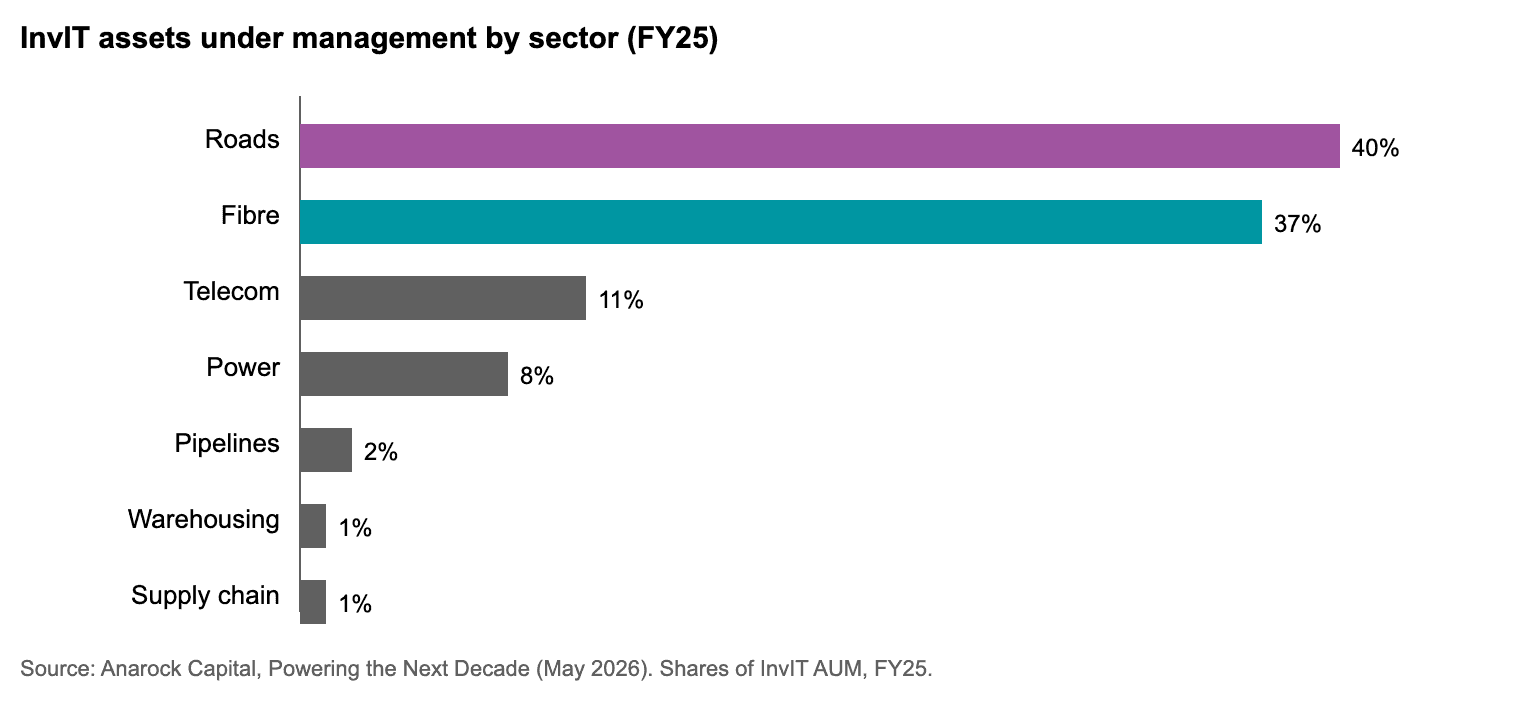
That contracted base is also narrow. Roads and fibre together make up more than three-quarters of InvIT assets under management, with power, telecom and pipelines accounting for most of the rest.
One honest caveat remains before comparing returns at all. The most-quoted "India REIT" performance number comes from the NSE Nifty REITs and InvITs index, which is roughly 30% InvITs (India REITs: Taking a Stride, Q2 FY26). So even the benchmark people cite for one vehicle is partly the other, and the comparison that matters is between the underlying assets themselves.
Matching the structure to the asset you hold
An asset owner rarely starts with the vehicle. In our experience the conversation runs the other way: the starting point is the asset already on the books, and the real question is which wrapper, if any, fits it.
A REIT fits an owner of stabilised, well-let Grade A commercial property, and an allocator who wants liquid, equity-like exposure to it: rent that re-prices upward as leases reset, daily pricing on an exchange, and the access that came with the 2025 reclassification, when SEBI moved REITs into the equity category. The buyer accepts a market concentrated in six trusts and weighted heavily to offices. Our full view of the listed market sits in the Anarock outlook on REITs in India.
An InvIT fits a different holder and liability. A long-horizon buyer such as an insurer or pension fund, matching assets to decades-long obligations, values the contracted cash flows of a road or transmission line and the higher current income they throw off; the leverage headroom and finite concession are features, not flaws. A sponsor uses the InvIT to monetise completed assets and recycle capital into new ones, the same logic a REIT offers an office owner.
When the honest answer is neither
Not every strong asset belongs in a listed trust. Some of the best an owner holds will not list as either a REIT or an InvIT, and forcing them into the wrong wrapper can destroy value. A conventional REIT needs scale, usually asset value in the tens of thousands of crore, and both structures demand completed, income-producing assets. A single mid-sized building or a half-let development fails those tests.
The clearest case is a sub-scale commercial asset. A stabilised office worth, say, ₹120 crore is too small for a full REIT, whose floor sits at ₹500 crore, and too illiquid for private buyers to price well. The SM REIT, a lighter listed route SEBI created in 2024 for a single scheme of completed property valued from ₹50 crore to just under ₹500 crore, was built for it; the SM REIT framework sets out when it makes sense. The other case is development or control, where a direct or private vehicle usually prices the risk better.
| What you hold or want | Route that usually fits | Why |
|---|---|---|
| Stabilised, well-let Grade A commercial portfolio; you want a liquid, equity-like holding | Buy or list a REIT | Daily pricing, index eligibility since the 2025 equity reclassification, and rental reversion built in |
| Operating infrastructure with long, contracted cash flows; you want higher current income matched to long liabilities | Hold or back an InvIT | Contracted tolls and charges, leverage headroom to 70%, and duration that suits insurers and pension funds |
| A single stabilised building between ₹50 crore and just under ₹500 crore | List an SM REIT | Below the ₹500 crore floor of a full REIT, but inside a regulated, listed wrapper |
| A value-add, under-construction or control position you mean to reposition | Hold directly or through a private vehicle | Listed trusts need completed, income-producing assets; development risk belongs outside them |
On the mandates this desk advises, the question usually arrives attached to a single asset, and a single asset qualifies for neither.
Where the capital is moving now
Capital is moving back into exactly the assets these trusts hold. Private equity inflows rose 23% year on year to $2.7 bn in H1 FY27, the strongest first half since H1 FY23 (FLUX, H1 FY27). Commercial office took the largest share at 35%, almost all as equity, much of it from domestic funds and REITs buying leased Grade A assets for the rental yield.
That matters for the REIT side of the choice. The six listed REITs now manage more than 210 mn sq ft of Grade A space, with gross assets under management of about $33 bn as of H1 FY27, and the runway is long: only a small share of the roughly 550 mn sq ft of REIT-eligible office stock is listed. More listings give a private owner a more reliable exit, and a way to recycle capital into new deals.
The InvIT side runs the same logic a different way, letting operators monetise completed roads, power and fibre and redeploy into the next phase. Both vehicles are becoming deeper, more reliable exits with every listing, which rewards the owner who has an asset stabilised and ready to list or sell while capital is moving toward it.
Key takeaways
The choice turns on the asset an owner holds, not on a view of which vehicle is better.
- A REIT owns rent-yielding Grade A property and an InvIT owns operating infrastructure, and that difference sets yield, duration, leverage and risk.
- Leverage and liquidity follow the asset: a REIT caps borrowing at 49% and trades as one of six equity-reclassified trusts, while most of the 27 registered InvITs are privately placed and can gear to 70%.
- Match the vehicle to the mandate, and recognise when neither fits: a sub-scale building belongs in an SM REIT, a development or control position in a direct or private hold.
Where this sits at Anarock
Anarock Investment Banking advises asset owners, developers and institutional investors on REIT and InvIT structuring, pre-listing preparation and placements, drawing on the same first-party data behind this analysis. The investment banking desk works across the listed and private routes to market, including the SM REIT window for sub-scale assets.
Frequently asked questions
What is the difference between a REIT and an InvIT in India?
Both are SEBI-regulated listed trusts that must distribute at least 90% of their net distributable cash flow. A REIT owns rent-yielding Grade A commercial property - offices and malls - whose rent re-prices upward as leases reset. An InvIT owns operating infrastructure such as roads, power lines, pipelines and fibre, earning tolls, user charges and long-term contracts.
Which is better for an institutional portfolio, a REIT or an InvIT?
Neither is better in the abstract; each fits a different asset and liability. A REIT suits an allocator wanting liquid, equity-like exposure to commercial rent and its upside. An InvIT suits a long-horizon holder, such as an insurer or pension fund, wanting contracted income and duration to match long liabilities. For many portfolios the two are complements.
How do REIT and InvIT yields compare?
A REIT in India pays a trailing-twelve-month distribution yield of 5.1-6.0%, set to grow as leases reset at higher rents - adding 15-24% to in-place rent over three to four years (India REITs: Taking a Stride, Q2 FY26). An InvIT pays more up front, but part can be a return of capital over a finite concession. A REIT yield compounds; an InvIT yield amortises.
How much can a REIT or an InvIT borrow?
A REIT is capped at 49% of asset value. An InvIT can borrow up to 70%, provided it carries an AAA rating, at least six distributions and unitholder approval; otherwise it too is held to 49%. The higher ceiling suits infrastructure, where contracted cash flows support more debt, but it raises sensitivity to interest rates.
How large are the REIT and InvIT markets in India?
India runs six listed REITs with a combined market capitalisation of about ₹2.08 lakh crore as of 15 May 2026 (Powering the Next Decade, May 2026), managing more than 210 mn sq ft of Grade A space. Registered InvITs have grown from four in FY19 to 27 by FY25, though only a handful are publicly listed. Most of the roughly 550 mn sq ft of REIT-eligible office stock is still unlisted.
Can a developer or fund use a REIT or an InvIT as an exit?
Yes. A REIT listing, or a sale into a REIT that already trades, is a primary liquidity event for stabilised commercial assets, and an InvIT does the same for completed infrastructure. Private equity inflows rose 23% to $2.7 bn in H1 FY27, with office the largest asset class (FLUX, H1 FY27).
When is neither a REIT nor an InvIT the right structure?
When the asset is too small or not yet stabilised. A conventional REIT needs scale, and both listed trusts require completed, income-producing assets. A single stabilised building between ₹50 crore and just under ₹500 crore fits the SM REIT route SEBI created in 2024. A value-add or control position usually prices better as a direct or private hold.
Sources
- Anarock Capital, India REITs: Taking a Stride (Q2 FY26), data as of 30 September 2025 - REIT distribution yields, re-leasing spreads and the NSE Nifty REITs and InvITs index.
- Anarock Capital, Powering the Next Decade (May 2026) - the six listed REITs and market cap as of 15 May 2026, REIT-eligible office stock, and the InvIT count and sector-wise AUM.
- Anarock, FLUX - Market Monitor for Capital Flows in Indian Real Estate (H1 FY27), April to September 2026 - private equity inflows and listed-REIT scale.
- Securities and Exchange Board of India, SEBI (Real Estate Investment Trusts) Regulations, 2014, and SEBI (Infrastructure Investment Trusts) Regulations, 2014.
- Anarock, REITs in India: institutional outlook, listing headroom and REIT-readiness (2026).
- Anarock, SM REIT framework for asset owners: thresholds, structure and when to list.