
23 Min Read
01 October 2026REITs in India: Institutional outlook, listing headroom and REIT-readiness (2026)
Share
Table of Contents+

TL;DR
- The listed market is small and office-heavy. The five largest trusts held ₹2,34,800 crore of gross asset value across 176.3 mn sq ft of leasable area, at 91% committed occupancy, on 30 September 2025 (Anarock Capital, Indian REITs: Taking a Stride, Q2 FY26).
- Most eligible stock has yet to list, and a lighter route is opening the door. For smaller and single-asset portfolios, the SM REIT window covers a ₹67,000-71,000 crore monetisation pool.
- Among the major Asian REIT markets India ranks third by market capitalisation, behind Japan and Singapore, yet it has returned more than any of them over five years, +8.9% against +2.2% by Japan.
- A 2025 equity reclassification by SEBI moved REITs into the equity category, opening them to mutual fund and index money after years when ownership sat largely with wealthy individuals.
- For owners and private equity, a REIT has become an increasingly important way to exit a stabilised office, and the first deals under each route have set pricing others can point to.
Institutional outlook
The listed REIT market in India
Owning Indian commercial property at institutional scale once meant buying the buildings outright, or backing the developers who did. Today an investor can also own it through a listed trust priced daily like any public security. REITs in India are now an asset class of six such trusts, with a combined market capitalisation of about ₹2.08 lakh crore.
Two changes made that possible. The first is regulatory. The regulator now counts a REIT as equity, which widens the pool of investors allowed to own one. The second is supply. A sixth trust has joined the listed market. Together they move the asset class out of a niche once held mostly by wealthy individuals and into the reach of mutual funds, index money and large institutions.
What these trusts mostly hold is office space. Five of the six own Grade A office parks, meaning the newest and highest-quality office space a trust can hold, and only one, Nexus Select Trust, holds shopping centres, so an investor in the listed market is buying, above all, Indian office demand. The eligible stock that could still list is therefore mostly the rest of the country's Grade A offices, and most of that stock is still privately owned. That unlisted part is the room the market has to grow into. A small and medium REIT (SM REIT) tier, introduced by the Securities and Exchange Board of India (SEBI) in 2024, is only beginning to bring single assets and smaller portfolios into the same regulated form.
On 15 May 2026 the six listed trusts held a combined market capitalisation of about ₹2.08 lakh crore, or ₹2,07,504 crore to be exact, per the Anarock report Powering the Next Decade (May 2026). The newest of them, Bagmane Prime Office REIT, listed only that month, so the investable set is still being assembled one trust at a time.
The fullest operating picture comes a quarter earlier, on 30 September 2025, when the five established trusts carried a combined market capitalisation of about ₹1,65,903 crore. Their gross asset value (GAV), the appraised worth of the buildings, was higher at ₹2,34,800 crore, and their enterprise value, the equity plus the net debt, stood at ₹2,21,894 crore (Anarock Capital, Indian REITs: Taking a Stride, Q2 FY26). Asset value sits above market capitalisation for two reasons. The properties are valued before the debt against them, and units can trade below the appraised worth of the buildings behind them.
The property behind those numbers is institutional-grade. The five trusts hold 176.3 mn sq ft of leasable area, 165.3 mn sq ft of it offices and 11 mn sq ft retail. Most of that is already built and earning, with 145.5 mn sq ft completed against 30.8 mn sq ft still under construction or planned.
Committed occupancy is 91%, and every trust is at or above 90%. That is the kind of portfolio a large fund can rely on, with stabilised cash flows, blue-chip tenants such as Google, Amazon, Cisco and JP Morgan, and distributions an investor can forecast.
Table 1. The five listed REITs in India, scale and performance snapshot (as of 30 September 2025)
| REIT | Market cap (₹ crore) | GAV (₹ crore) | Portfolio (mn sq ft) | Committed occupancy | Price gain since listing |
|---|---|---|---|---|---|
| Embassy Office Parks | 39,995 | 63,980 | 50.8 | 90% | +37.0% |
| Mindspace Business Parks | 27,705 | 41,020 | 38.2 | 92% | +49.6% |
| Brookfield India | 21,956 | 36,000 | 29.1 | 90% | +24.7% |
| Nexus Select Trust | 25,089 | 29,250 | 11.9 | 96% | +60.8% |
| Knowledge Realty Trust | 51,160 | 64,550 | 46.3 | 92% | +12.0% |
| Total | 1,65,903 | 2,34,800 | 176.3 | 91% | - |
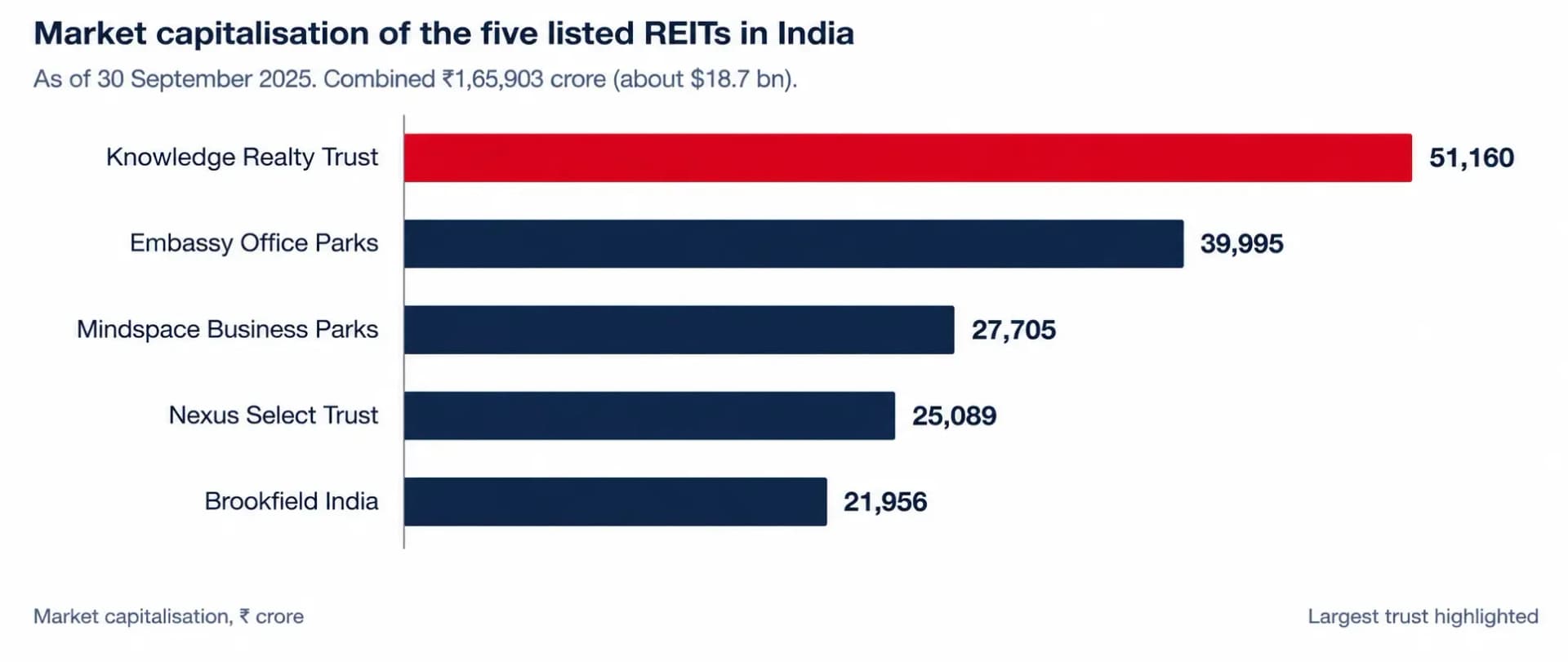
That 91% committed occupancy is worth a closer look, because the fullest book in the listed set belongs to its least diversified trust.
Bagmane Prime Office REIT is the clearest example. It brought a single-city Bengaluru portfolio to the market: six top-grade business parks totalling 20.3 mn sq ft, of which about 16.6 mn sq ft is already completed. The issue was priced at ₹95-100 per unit and raised ₹3,405 crore, and the trust carried a market capitalisation of ₹35,393 crore on 15 May 2026.
It is sponsored by Bagmane Realty and Infrastructure LLP, part of the Bengaluru-based Bagmane Group, with Blackstone holding a minority stake taken before the December 2024 IPO (Outlook Business and Business Standard, August 2026). Committed occupancy was 98.8% at
31 December 2025, the highest among the listed office REITs in India (Business Standard, August 2026).
High committed occupancy and a high-quality portfolio are not the same thing, and the newest trust shows why. Its 98.8% occupancy is genuine, but its entire book sits in one city and one asset type, so the same near-full portfolio that reads as dependable is also a concentrated bet on a single office market, with more room to fall than to rise. That pairing of quality and concentration runs through the whole listed set.
For an institutional investor, three questions then decide whether the listed trusts belong in a portfolio. What do those trusts pay today? How much of the eligible stock could still convert into listed form? And how does a private building become a tradable trust? The first answers whether to own the listed trusts now. The other two decide how much larger the opportunity behind them can grow.
REIT yields in India
The first of those three questions is what the listed trusts pay today, and whether that income holds. Indian REITs pay a distribution yield of 5.1-6.0% on a trailing-twelve-month basis, and the income behind that yield is set to rise as leases reset.
A REIT in India rewards an investor in two ways, income and price, and both begin with rent. The first is income. The trust pays out most of its rental cash as a distribution, which shows up as a yield, the annual cash paid out as a share of the unit price.
That income is not fixed, and it is set up to grow. Near-full buildings keep the existing rent flowing, and because the listed trusts took more than 20% of all gross office leasing across India in Q2 FY26, their space keeps re-filling as leases roll over, so occupancy holds and they keep the pricing power to raise rents. As older leases expire, the trust re-lets that space at current market rates, a step up called a re-leasing spread now running 20-36% above the expiring rent. Higher rents lift net operating income, the rent a building earns after running costs, and that income is what funds the distribution. The report Indian REITs: Taking a Stride expects in-place rents to catch up with the market over the next three to four years, adding a further 15-24% to income, so the yield an investor buys at entry understates what the position will pay once its leases reset.
The second reward is price, and it draws on the same rising rents. Gains since listing range from +12.0% to +60.8% across the trusts (Table 1), varying mainly because each has traded for a different length of time and listed when the market was stronger or weaker. Rising rents lift value in two ways. Higher net operating income raises what a building is worth directly, and values also move with cap rates, the annual net income a buyer accepts as a percentage of the price. Office exit cap rates sit at 7.5-8.5%, and a lower cap rate means a higher price for the same income, so any compression lifts the value of a stabilised office even before rents rise.
The return holds up because the balance sheet behind it is strong. Each of the five established trusts carries a CRISIL AAA rating, the highest domestic credit grade, on an average cost of debt of 7.4% and interest cover of 2.7 times, with valuations at 14-17 times EV/EBITDA.
Taken together, the yield an investor buys today is more likely to rise than to fall from here. The income behind it is contracted to increase as leases reset, and the balance sheet supporting it is investment-grade, so the distribution can grow without the credit weakening.
India versus its Asian peers
A durable, investment-grade income invites a comparison with other markets. Among the major Asian REIT markets, India ranks behind only Japan and Singapore by size, and on the most-quoted return measure it has outperformed all of them over five years.
That measure is not a pure-REIT one. It comes from the NSE Nifty REITs and InvITs index, which is roughly 30% InvITs, so the +8.9% is a blended REIT-and-InvIT price return that flatters a pure-REIT comparison. Read as a blend, India still ranks ahead of its regional peers, though the margin is not a like-for-like REIT result.
The gap is clearest over five years. The index price return of +8.9% beats +2.2% by Japan, and on that measure India leads the peer set, while Singapore and Hong Kong sit in negative territory.
Two features set the market apart. It pays unitholders quarterly, against the semi-annual norm elsewhere in the region, and it operates under a statutory borrowing cap of 49%.
Table 2. REITs in India versus Asian peers, as of 30 September 2025
| Market | Market cap ($ bn) | Listed trusts | Portfolio (mn sq ft) | Avg distribution yield (TTM) | 5-yr annualised index price return |
|---|---|---|---|---|---|
| India | ~18.7 | 5 | ~176 | 5-6% | +8.9% |
| Japan | ~110.0 | 58 | >400 | 3-5% | +2.2% |
| Singapore | ~76.5 | 38 | ~350 | 4-6% | -3.6% |
| Hong Kong | ~16.7 | 11 | ~55 | 6-9% | -10.1% |
Since that quarter-end the total has grown to about $23.4 bn across six listed trusts, though it remains a fraction of the older markets above it. India is still one of the smallest of these markets, and part of its five-year lead reflects a young market climbing from a low base rather than a mature one holding its ground.
Listing headroom
The unlisted Grade A pool
The peer comparison sizes the listed market as it stands. The second of those three questions is how much larger it can become, and most of that opportunity has yet to list. Only about 37% of REIT-eligible office stock in the top seven cities is listed today, 198 mn sq ft of a 520 mn sq ft base (Anarock, Powering the Next Decade, H1 FY26). The other two-thirds sits in private hands, and the pace at which it converts into listed or SM REIT form is what sets how fast the investable menu grows.
The headline size of the market can hide that gap. By market capitalisation the listed market in India already outranks an established Asian centre, Hong Kong. On 30 September 2025 the Indian REIT market cap was ₹1.66 lakh crore ($18.7 bn) across five trusts, against $16.7 bn for Hong Kong across 11 trusts, and it has risen further since. India has reached that scale on only five trusts and a fraction of its eligible office stock, which shows the constraint is how little has come to market rather than any shortage of investor appetite. The listed market has also rallied about 10.5% in Q2 FY26, on the NSE measure that tracks REITs alongside infrastructure investment trusts (InvITs), which means a large and rising valuation now rests on a small slice of the stock that could eventually list.
New asset classes and SM REITs
The investable menu widens from here in two main ways. The first is more product types. The report Indian REITs: Taking a Stride sees the next listings moving beyond offices and retail into logistics, data centres, healthcare, residential and hospitality, the path Singapore and Japan already took. The second is the SM REIT route, a lighter path that brings single-asset or smaller portfolios into a regulated wrapper, and Anarock sizes the monetisation window it opens at ₹67,000-71,000 crore. How quickly that Grade A stock and those new asset classes convert into trusts is what sets the pace at which the investable set widens beyond today's office-heavy six.
REIT-readiness
What makes a portfolio REIT-ready
A young market grows by admitting new assets, which turns the question around, from the buyer to the seller. The seller is a developer, fund or private equity owner deciding whether to bring an asset to market, and their first question is whether a portfolio even qualifies.
REIT-readiness in India is the structural standard a portfolio must meet to list as a trust or be bought by one, and it requires committed occupancy at or above 90%. The listed trusts have already set that standard, and it rests on four things a buyer or an index will check.
The first is the assets themselves. A listable portfolio has to be stabilised, meaning largely built, let and already earning rent rather than still filling up. Across the listed base, 83% is complete by leasable area and 95% by value, with committed occupancy at or above 90%. Some under-construction space can go in, but the earning core has to be running first.
The second is the tenant base, which has to be diversified, blue-chip and on long leases. What we see in diligence is that heavy reliance on one tenant, or one micro-market, shows up immediately as a discount to value.
The third is structure and credit: clear title and approvals at the asset level, and an AAA-equivalent balance sheet. That rating is what lets a trust raise 10-year REIT bonds and commercial paper at a competitive cost.
Scale is the fourth requirement, and a full listing usually needs asset value in the tens of thousands of crore, though smaller or single-asset portfolios now have the SM REIT route instead.
For most sellers the buildings are not the hard part. The structure and the paperwork behind them are, and a seller usually starts preparing years ahead of a listing.
More office stock is reaching this standard as the office market in India institutionalises, a shift covered in an Anarock note on the commercial real estate market in India. A portfolio that is ready before it goes to market can list on its sponsor's timing rather than the market's, and readiness usually earns it a better price when it does.
The three REIT exit routes
Once a portfolio meets that standard, its owner has a route out that barely existed a few years ago. A REIT has become an increasingly important exit for a developer, a fund or a private equity owner, most visibly in the ₹13,125 crore Ecoworld deal struck at a 7.7% cap rate.
A stabilised office no longer has just one buyer. A REIT now offers three routes out: a full listing, a sale into a trust that already trades, or an SM REIT for sub-scale assets. Two deals in Q2 FY26 put a price on the first two.
The listing route is the most direct of the three. Knowledge Realty Trust, the largest REIT in India based on GAV, listed on 18 August 2025 at ₹104 per unit, a 4% premium to its issue price, and the sale was oversubscribed 12.48 times. The sponsor used about 97% of the proceeds to pay down debt.
The sale-into-trust route showed its pricing in the binding agreement by Brookfield India to buy Ecoworld, Bengaluru, a 7.7 mn sq ft campus, for ₹13,125 crore. The largest 100% office acquisition in the country, it was priced at a 7.7% cap rate on estimated FY27 net operating income and a 6.5% discount to gross asset value.
That deal now sets the reference point for any private equity (PE) seller moving an income-yielding office into a REIT platform.
The third route serves the assets too small for either. The SM REIT window, a regulated step on from the fractional-ownership schemes covered in fractional ownership: is it a trend that is here to stay?, is the emerging way to monetise sub-scale portfolios.
Which route prices an asset best depends on its size and how far it is stabilised. What has changed for a seller is that all three routes are now open, and the recent deals have put a reference price against two of them, with the SM REIT route still establishing its own.
What the SEBI framework changed
Every one of those routes runs through the SEBI framework, the rulebook each trust lists and operates under. The 2025 reclassification by SEBI now lets a REIT count as equity, which widens the group of investors allowed to own one.
SEBI first notified the REIT rules in 2014 and added a master circular in 2023, but the turn came in 2025. The 2025 equity reclassification by SEBI, effective 1 January 2026, made REITs eligible for mutual fund equity allocations, and for equity indices from 1 July 2026. The rule is set out in the SEBI (Real Estate Investment Trusts) Regulations, 2014, last amended 18 April 2026.
That single change puts REIT ownership within reach of passive and institutional money, where in practice it had been the preserve of wealthy individuals.
The protections an institution cares about are written into the rules. Consolidated borrowing is capped at 49% of asset value, and at least 90% of net distributable cash flow must be paid out, in quarterly instalments. Smaller portfolios have the same wrapper through the SM REIT framework, which allows raises from ₹50 crore and a minimum of 200 investors.
An equity label, a hard borrowing cap and a mandatory payout are what move a REIT from a niche product into something a large institution can actually hold.
The listed market is small, but it is high-grade, liquid, well-regulated and established, and for an institution whether the asset class is real is no longer in doubt.
The bigger opportunity is not in the listed market but in what has not yet reached it. Two-thirds of eligible Grade A stock, the newer asset classes beyond offices, and the mass of sub-scale buildings all sit outside a listed structure today. Moving that private pool into trusts, through full listings, sales into existing trusts and the SM REIT route, is the work that lies ahead.
For now the market stays small, high-grade and office-heavy. What will change that is neither demand nor regulation, both already in place, but the pace at which private owners choose to convert their buildings into trusts. That pace, decided one building at a time, is what will determine how large the REIT market in India becomes.
Key takeaways
- The Indian REIT market holds two facts at once. The listed set is small and unusually high-grade, and the far larger pool of eligible stock has barely begun to convert.
- The case to own the listed trusts is already made. Distribution yields of 5.1-6.0% sit on near-fully-let, investment-grade balance sheets, the income behind them is contracted to rise as leases reset, and the 2025 equity reclassification by SEBI has opened them to mutual fund and index money.
- The risk to weigh against that is concentration, not quality. The listed market holds six trusts and leans heavily on offices, and the newest listing shows how a nearly full book can also be a bet on a single city.
- Whether the market grows from here is not really a question of demand or regulation, both of which are in place. It turns on how quickly private owners convert Grade A stock, new asset classes and sub-scale buildings into listed and SM REIT form.
- The first exits have set the terms for sellers. Knowledge Realty Trust retired debt with about 97% of its August 2025 listing proceeds, and the ₹13,125 crore Ecoworld deal was struck at a 7.7% cap rate, giving a future seller a public reference for a listing and for a sale into a trust.
- The remaining question for an allocator is one of timing, not direction. The listed market is real and its growth path is clear, so entering now means buying a scarce, high-grade asset class before its float deepens, and holding concentration risk until it does.
Where this sits at Anarock
The investment banking desk at Anarock Capital works on REIT and SM REIT structuring, pre-IPO portfolio preparation and institutional placements, drawing on the same first-party data behind this analysis.
For the wider market view, see the Anarock coverage featuring Shobhit Agarwal, managing director and chief executive of Anarock Capital, on institutional capital and the investment outlook (August 2026) and on where deal activity is concentrating (July 2026).
Frequently asked questions
How big is the REIT market in India?
Six trusts are listed, with a combined market capitalisation of about ₹2.08 lakh crore in mid-2026 (Anarock, Powering the Next Decade), enough to rank India third among the major Asian REIT markets, behind Japan and Singapore. Five of the trusts hold office parks and one holds retail, and a newer SM REIT tier is starting to bring smaller, single-asset portfolios into the same regulated form.
How much listing headroom do REITs in India have?
Only about 37% of REIT-eligible office stock in the top seven cities is listed, 198 mn sq ft of 520 mn sq ft (H1 FY26), leaving most eligible Grade A space still privately held. How quickly that runway is used depends on the pace at which Grade A stock and new asset classes - logistics, data centres, healthcare, hospitality - convert into trusts, alongside an SM REIT monetisation window of ₹67,000-71,000 crore for smaller portfolios.
What distribution yields do REITs in India offer?
Trailing-twelve-month distribution yields ranged from 5.1-6.0% as of Q2 FY26, compressing 60-120 basis points over FY25 as unit prices rose. Because those trusts keep re-letting expiring leases at higher rents, the distribution behind that yield is set to keep growing. Investors also earned price gains since listing of +12.0-60.8% across the established trusts, on investment-grade balance sheets.
Are REITs in India a good institutional investment?
Allocators seeking stabilised commercial income find strong fundamentals: 91% committed occupancy, CRISIL AAA credit, quarterly distributions and the 2025 equity reclassification by SEBI that widened institutional access. The main consideration is concentration: the market is office-heavy and holds only six trusts. Product diversification into logistics, data centres and other assets is expected to reduce that concentration over time.
What makes a portfolio REIT-ready?
A REIT-ready portfolio has stabilised Grade A assets with committed occupancy at or above 90%, a diversified blue-chip tenant base on long leases, a clean structure with clear title at the asset level, an investment-grade balance sheet, and enough GAV scale. In practice the parts hardest to fix are structural: title and approvals, tenant concentration, and a balance sheet that can carry REIT-grade debt. Sub-scale or single-asset portfolios can now use the SM REIT route introduced by SEBI in 2024.
Can developers use a REIT as an exit?
Yes. A REIT listing, or a sale into a REIT platform, is a primary liquidity event for stabilised commercial assets. Knowledge Realty Trust used about 97% of its August 2025 listing proceeds to retire debt, and the ₹13,125 crore Ecoworld acquisition by Brookfield India set a 7.7% cap-rate benchmark for income-yielding office exits. Smaller or single-asset holdings that cannot support a full listing can take the SM REIT route instead.
How do REITs in India compare with Singapore and Japan?
Among the major Asian REIT markets, India ranks behind Japan and Singapore and ahead of Hong Kong by market capitalisation, at $18.7 bn on 30 September 2025 against $110 bn for Japan, $76.5 bn for Singapore and $16.7 bn for Hong Kong. It still delivered the best five-year annualised index price return, +8.9%, ahead of +2.2% by Japan and negative returns for Singapore and Hong Kong. India also distributes to unitholders quarterly, against the semi-annual norm elsewhere in the region.
What did the 2025 REIT reclassification by SEBI change?
In 2025 SEBI reclassified REITs as equity, effective 1 January 2026, making them eligible for mutual fund equity allocations and, from 1 July 2026, equity indices. Combined with the 2023 master circular, the 49% borrowing cap and the mandatory 90% payout of net distributable cash flows, this moves REITs in India from a niche product into a mainstream institutional allocation.
Sources
- Anarock Capital, Indian REITs: Taking a Stride - Building Momentum with Scale & Performance (Q2 FY26 Newsletter Edition), data as of 30 September 2025.
- Anarock, Powering the Next Decade: Real Estate Finance Transformation in India (May 2026); six listed REITs and market caps as of 15 May 2026; REIT-eligible office-stock penetration as of H1 FY26.
- Outlook Business, Bagmane Prime Office REIT sets IPO price band at ₹95-100 per unit, May 2026 (sponsor, Blackstone pre-IPO stake, price band and issue size).
- Business Standard, Bagmane Prime Office REIT eyes nearly doubling portfolio over next 7-8 years, 13 August 2026 (portfolio of six Grade A+ parks, 20.3 mn sq ft, and 98.8% committed occupancy as of 31 December 2025).
- Securities and Exchange Board of India, SEBI (Real Estate Investment Trusts) Regulations, 2014 (last amended 18 April 2026), including the SM REIT framework.
- Anarock, Shobhit Agarwal on institutional capital and the investment outlook, media coverage roundup, August 2026.
- Anarock, Santhosh Kumar and Shobhit Agarwal on where deal activity is concentrating, media coverage roundup, July 2026.
- Anarock, Commercial real estate market in India: making the presence felt.
- Anarock, Fractional ownership: is it a trend that is here to stay?