
13 Min Read
03 November 2026Property due diligence in India: the nine checks that change a price
Share
Table of Contents+

TL;DR
- Due diligence in India prices risk; it does not just confirm ownership. The country records deeds rather than guaranteeing title, so a buyer inherits any hidden defect and traces ownership back thirty years.
- A record market shortens the look. Net office leasing reached 27.4 mn sq ft across the top seven cities in H1 CY2026 while completions of 22.2 mn sq ft trailed absorption by 5.2 mn sq ft, so inventory is drawing down and the seller holds the leverage (Anarock).
- Nine workstreams run at once, each able to stop the deal: title and land records, encumbrance, RERA registration, approvals and the occupancy certificate, litigation, rent roll, structural and services condition, ESG, and tax and stamp duty.
- Price turns on the cap rate: at 7.5-8.5% (Anarock Capital, as of 30 September 2025) a verified income converts into a value, so a thin lease or an unapproved floor shows up as a wider cap rate and a lower price.
Introduction
Historically, due diligence on a commercial asset in India was the last box an institutional buyer ticked before closing, a legal formality that rarely moved the price. That is no longer how acquisitions are won. As more domestic and foreign capital has moved in, and buildings change hands at institutional scale rather than between local owners, diligence has moved to the front of the process, where it sets the price instead of confirming it.
The reason is structural. India registers transactions but does not guarantee title, so a buyer inherits whatever defect the paperwork hides, and in an active market that defect is expensive. Net office leasing across the top seven cities reached 27.4 mn sq ft in H1 CY2026, and the market is drawing down vacant stock faster than it replaces it. So a seller holds the leverage, and a buyer gets less time to look (India Office Market Update, H1 CY2026). This playbook sets out the diligence a buyer runs before committing capital, and what each finding changes about the deal's price or structure.
The nine workstreams of an acquisition playbook
For a fund, occupier or developer, the question is never whether a building is attractive, but whether it is worth the asking price once every claim on its title, income and fabric has been found and costed. That work is the underwriting, the assessing and pricing of risk. A buyer runs it as nine checks at once, inside an exclusivity window, because any one can end the deal and the slowest sets the timetable. The findings then reconcile into one risk register.
| Workstream | What it verifies | What a red flag changes |
|---|---|---|
| Title and land records | Ownership chain, mother deed, mutation and revenue records | A break in the chain restructures or ends the deal |
| Encumbrance and security interest | Mortgages and charges on a CERSAI search | An unreleased charge becomes a condition precedent |
| RERA registration and disclosures | State registration and project-level disclosures | A missing registration delays or blocks the sale |
| Approvals and occupancy certificate | Sanctioned plans, floor space, clearances, occupancy certificate | An approval that does not match the built area caps the value |
| Litigation and attachment search | Suits, attachments or insolvency against the seller | A live dispute moves the price or widens the indemnity |
| Tenancy and rent roll | Leases, rents, escalations and expiries, against the deeds | Income that reads fuller than it is lowers the price |
| Structural and services condition | Structural life, services and measured leasable area | Deferred capital expenditure and area inflation pass to the buyer |
| ESG and certification | Green-rating status and energy performance | A weak rating narrows the pool of occupiers |
| Tax and stamp duty | Property-tax and GST position, stamp duty on transfer | Arrears and duty change the net cost of the asset |
Three decide most transactions, in the desk's experience: title and encumbrance, the statutory approvals behind the building, and the income the rent roll supports.
Title and encumbrance cannot be delegated
Title diligence is where the acquisition case is most often won or lost, because India registers deeds, not title. The Transfer of Property Act, 1882 lets immovable property pass only by a registered instrument, and the Registration Act, 1908 makes registration compulsory. Yet registration records only that a transfer happened, without certifying that the seller held good title. India has no Torrens system, the state-backed title guarantee used elsewhere. So the buyer rebuilds ownership itself, tracing the mother deed and every conveyance since, and reconciling the chain against mutation and property-tax records so that the owner on the deed, the taxpayer and the occupier are the same. A break in that chain, or a gap the seller cannot explain, is enough to restructure or abandon the deal.
Beside it runs the encumbrance search, which tests for any charge against the asset. A buyer pulls an encumbrance certificate from the sub-registrar and searches the Central Registry of Securitisation Asset Reconstruction and Security Interest of India (CERSAI), the national register of charges set up under the SARFAESI Act, 2002. A charge recorded there is public notice, so an undisclosed mortgage becomes a condition precedent, an obligation the seller must clear before completion, usually from proceeds held in escrow.
The last strand is the search for disputes. A litigation and attachment check confirms that no suit, decree or tax attachment clouds the asset. Where the seller is a company under the Insolvency and Bankruptcy Code, 2016, a Section 14 moratorium freezes any transfer of its assets, so a counterparty in insolvency can stop a sale outright. A defect here is not a discount but a question of whether the deal can complete.
RERA, approvals and the occupancy certificate
Clean title answers who owns the land. The next workstream answers whether the building on it is legal to sell and to occupy. The Real Estate (Regulation and Development) Act, 2016 (RERA) covers commercial projects as well as residential ones. It requires a promoter to register a project where the land exceeds 500 square metres or the development runs to more than eight units. Registration also puts project-level information, including the sanctioned plans and completion schedule, on the state authority's page, which a buyer tests against what the seller represents.
Beyond RERA, the approval trail has to reconcile with the building that stands on the site. A buyer verifies the sanctioned plans and any deviation from them, the consumed floor space index (FSI), the ratio of built-up area a plot is permitted, against what has actually been built. The check also covers the fire and environmental clearances, and the occupancy certificate
(OC), which confirms the building may be lawfully occupied. An OC that does not match the built area, or floor space consumed beyond what was sanctioned, is among the most expensive findings in Indian diligence. The cost of regularising it, or the risk that it cannot be, lands on the buyer and caps the price.
The rent roll is where income is tested
An approved, unencumbered building is worth only what its income can be relied on to be. The financial workstream runs a rent-roll audit, a line-by-line check of every tenant, leased area, in-place rent, escalation, lock-in and expiry against the lease deeds and receipts, not a seller summary. From it the buyer derives the weighted average lease expiry (WALE), the time left on the leases weighted by area, measures each covenant, the tenant's financial strength, and sizes the gap between in-place and market rent on renewal.
The physical survey runs beside it. A surveyor assesses structural life, the mechanical, electrical and plumbing (MEP) systems, the facade and fire systems, and measures the actual leasable area against the area the seller charges for, since inflated chargeable area overstates income. Deferred capital expenditure, the repair the owner has postponed, is the other recurring finding the buyer inherits.
Location prices the income as much as the rent roll does, because a vacant floor re-lets at the local pace and the local rent: the same income underwrites to a different price across the top seven cities, and the city spread in H1 CY2026 was wide.
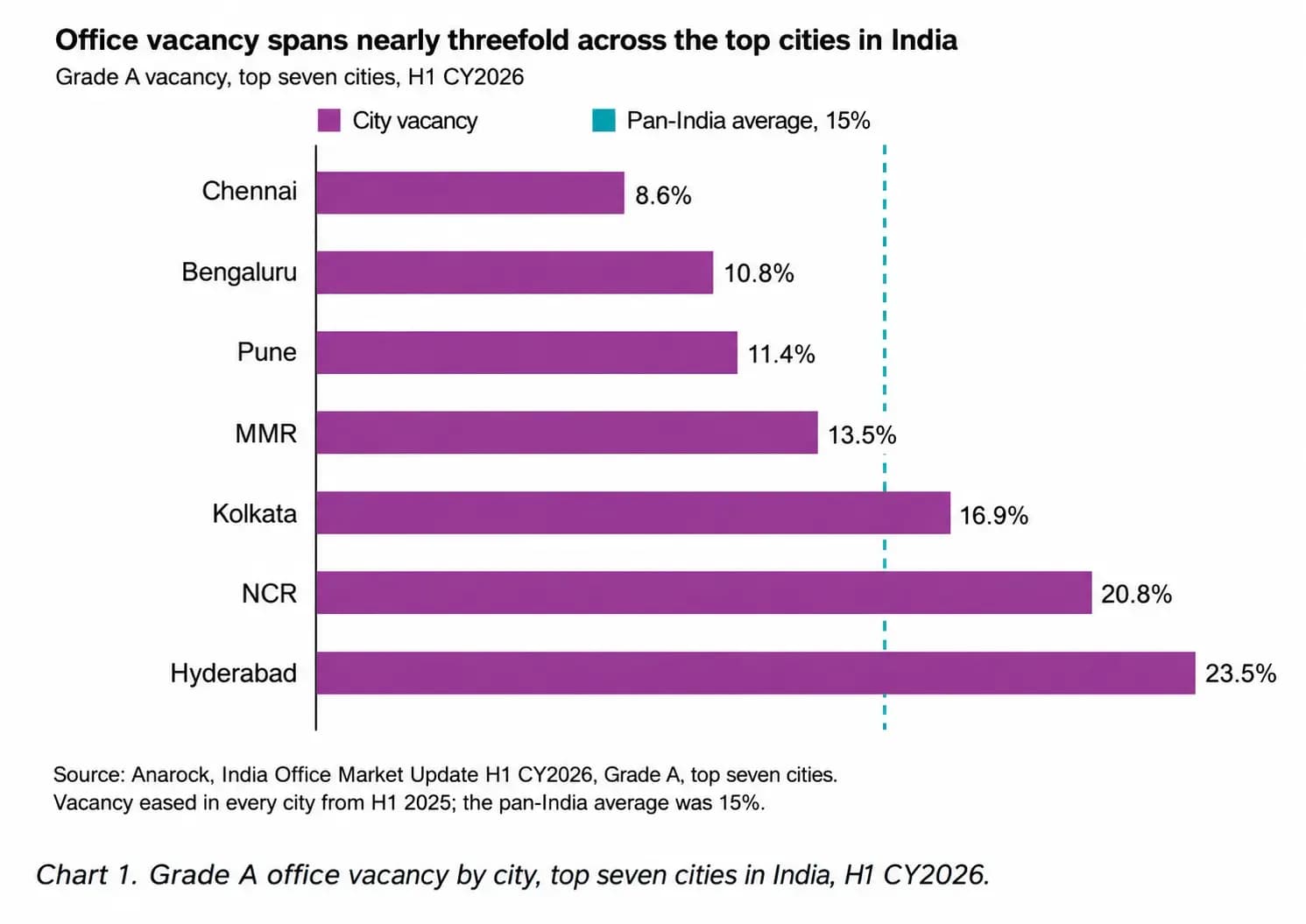
A buyer reads that spread into the underwriting. Where vacancy is high, as in Hyderabad at 23.5% or NCR at 20.8%, space re-lets slowly and at lower rents, so the buyer assumes a longer lease-up and a wider cap rate, lowering the value. Where it is tight, as in Chennai at 8.6% or Bengaluru at 10.8%, reversion supports income but entry yields compress. The number that prices the asset is the vacancy in its own micro-market, not the national average.
How a finding moves the price or the structure
A diligence finding is only useful once it changes something the buyer does, and most travel into the deal through one number, the cap rate. It converts that income into a value. At an office exit cap rate of 7.5-8.5% as of 30 September 2025, a verified net operating income divided by the rate gives the price a buyer can justify (Anarock Capital, Indian REITs: Taking a Stride, Q2 FY26). A thin covenant, a short WALE or slow-letting space reduces the income or widens the rate, and the value falls.
Not every finding is a price adjustment, and the difference is where structuring earns its keep. A quantified, one-off risk is re-priced into the number. A contingent or unresolved risk is carried by the terms instead: a condition precedent that the seller clears a charge or regularises an approval before completion, an escrow against a liability that may not crystallise, or an indemnity. For the seller, those terms separate a clean exit from value trapped in escrow. A defect in the chain of title, by contrast, is rarely a price at all; it is a reason the deal does not complete.
What diligence cannot do is price a risk the records do not disclose. A clean search is evidence of nothing worse found, not proof that nothing is there, and in a system of presumptive title that residual never falls to zero. The institutional buyer accepts it, sizes it, and insists on the title representations and indemnities that move as much of it as possible back to the seller. The output is not certainty but a price and a structure that reflect how much is known.
Key takeaways
Acquisition diligence in India converts what can be discovered about an asset into the price and terms a buyer should accept, and the market makes that discipline matter more, not less.
- Treat diligence as pricing, not paperwork. India records deeds without guaranteeing title, so the buyer reconstructs ownership over thirty years and inherits any defect it misses.
- Run the nine workstreams in parallel and let the slowest set the timetable, because title, encumbrance, approvals and the rent roll each carry a veto.
- Separate the statutory anchors from the commercial ones: the Registration Act and Transfer of Property Act for title, RERA and the occupancy certificate for the building, and CERSAI and the insolvency code for charges.
- Price the market locally: city vacancy runs from 8.6% in Chennai to 23.5% in Hyderabad against a 15% average, and it is the micro-market number that sets the lease-up and the cap rate.
- Resolve each finding deliberately: hold, re-price, or restructure through a condition precedent, an escrow or an indemnity, and keep the willingness to walk.
Where this sits at Anarock
At Anarock, the strategic advisory and valuations practice runs acquisition diligence, feasibility and valuation for funds and developers, reconciling the legal, technical and financial workstreams into one pricing view. For the wider market, see the Anarock reads on the 2026 office market outlook and the institutional outlook for REITs, and on the commercial real estate market in India, the key clauses in a commercial lease, and ESG in real estate.
Frequently asked questions
What is real estate due diligence in India, and what does it cover?
Real estate due diligence in India finds and prices every claim on a property before an acquisition completes. It spans nine parallel workstreams: title and land records, encumbrance, RERA registration, approvals and the occupancy certificate, litigation, the rent roll, physical condition, ESG, and tax and stamp duty. It matters because India registers deeds rather than guaranteeing title, so the buyer inherits any undisclosed defect.
What should an institutional buyer check before buying commercial property in India?
Check that title is clean over an unbroken thirty-year chain, that no charge sits on a CERSAI search, that RERA registration and the occupancy certificate match the building as built, that no litigation or insolvency clouds the seller, and that the rent roll holds up against the lease deeds.
How do you run title due diligence on a commercial asset in India?
Title diligence traces the mother deed and every conveyance since, by convention over at least thirty years, and reconciles the chain against mutation and property-tax records so that the owner on the deed, the taxpayer and the occupier are the same. An encumbrance certificate and a CERSAI search run alongside it, and a break in the chain or an unreleased charge becomes a condition precedent.
Does RERA apply to commercial real estate?
Yes. The Real Estate (Regulation and Development) Act, 2016 covers commercial projects as well as residential ones, and requires registration where the land exceeds 500 square metres or the development runs to more than eight units. A buyer verifies the registration, the sanctioned plans and the project-level disclosures the state authority publishes.
What is technical due diligence in property?
Technical due diligence is the physical survey of a building by a qualified surveyor, covering structural life, the mechanical, electrical and plumbing systems, and the actual leasable area against the area the seller charges for. Two findings matter most: chargeable-area inflation, which overstates income, and deferred capital expenditure, the postponed repair the buyer inherits.
How long does commercial property due diligence take in India?
For a single Grade A asset, institutional diligence typically runs four to eight weeks, and twelve or more for a portfolio or an asset with a title defect. Title and encumbrance verification set the critical path, followed by the technical survey and the rent-roll audit.
How does a diligence finding change the price a buyer pays?
Most findings travel into the deal through the cap rate, which converts net operating income into a value: at an office exit cap rate of 7.5-8.5% as of 30 September 2025, a thinner income or a wider rate lowers the price. A quantified one-off risk is re-priced; a contingent one is carried by a condition precedent, an escrow or an indemnity; a title defect stops the deal.
Sources
- Anarock Research, India Office Market Update, H1 CY2026, top seven cities, Grade A, data to 30 June 2026 - net leasing, completions, vacancy and city-level vacancy.
- Anarock Capital, Indian REITs: Taking a Stride - Building Momentum with Scale & Performance (Q2 FY26 Newsletter Edition), as of 30 September 2025 - office exit cap rate of 7.5-8.5%.
- Primary statutory sources (read as statute, not as a priced market series): the Transfer of Property Act, 1882; the Registration Act, 1908; the Real Estate (Regulation and Development) Act, 2016; the SARFAESI Act, 2002 and the CERSAI register created under it; and the Insolvency and Bankruptcy Code, 2016.