
14 Min Read
19 October 2026Private credit in Indian real estate: where AIF money actually lends in 2026
Share
Table of Contents+

TL;DR
- Private credit means a fund lending where a bank may not, almost always through a Category II AIF. Its share has shrunk: structured debt fell from 32% of real estate private equity inflows in FY23 to 16% in H1 FY27, while equity rose to 83% (Anarock, FLUX H1 FY27).
- Domestic investors supplied 48% of inflows in H1 FY27 against 16% in FY25, led by real estate AIFs and family offices, and that money has mostly bought rather than lent.
- Nearly 90% of residential capital in H1 FY27 arrived as structured debt, mainly small-ticket funding for project completion.
- Cost follows the stage, not the borrower: 18-20% a year for land and approvals against 7-9% for a stabilised operating asset.
- The 2025 project finance rules by the Reserve Bank of India bind banks and non-banking lenders, not AIFs, which is part of why the pricing gap holds.
Introduction
For most of the past decade, a developer who could not get a bank loan in India had one realistic alternative: a non-banking lender willing to price the risk the bank would not. Today that lender is often a fund instead.
The share of commercial real estate lending held by non-banking financial companies (NBFCs), measured against banks, fell from about 40% in FY18 to about 15% in FY25 after the defaults at IL&FS and DHFL, and much of the capital that replaced it was raised through Alternative Investment Funds (AIFs), the pooled vehicles the Securities and Exchange Board of India (SEBI) registers (Anarock Capital, Powering the Next Decade, May 2026).
Told as a growth story, that shift is accurate as far as it goes: real estate is the largest single destination for AIF money in India, at about 12% of roughly $8 bn invested across all AIF categories to December 2025. The flow data underneath is less comfortable: private equity inflows into Indian real estate rose 23% to $2.7 bn in H1 FY27 and domestic funds supplied 48% of that against 16% two years earlier, yet the structured debt share of those inflows halved, from 32% in FY23 to 16% (Anarock, FLUX, H1 FY27).
More money is arriving and less of it is lending, so private credit in India has not so much scaled up as narrowed: it now funds the few stages a regulated lender is barred from, and prices them accordingly.
The gap a regulated lender cannot fund
Land is the first thing a project needs and close to the last a regulated lender will finance. Banks are prohibited from funding land acquisition and approvals, and since an April 2022 circular an NBFC may disburse a real estate loan only once all key approvals are in hand, leaving AIFs the primary route for land (Powering the Next Decade, May 2026). The Reserve Bank of India (Project Finance) Directions, 2025 pressed further from 1 October 2025, requiring a lender to confirm 75% of the land is available before it disburses on a commercial real estate or housing project.
Private credit is the capital that fills that space: a loan from a fund rather than a deposit-taking institution, structured against the cash flows of a single project. The vehicle is almost always a Category II AIF, which Anarock identifies as the category most active in real estate debt and equity, against Category I, leaning to start-ups and infrastructure, and Category III, running hedge strategies. For a developer, what that buys is speed and a structure built around the project, not the balance sheet.
| Lender | Cost | Approval timeline | Leverage | Refinance access |
|---|---|---|---|---|
| Banks and housing finance companies (HFCs) | Lowest to moderate | Slowest, approvals needed | Conservative, 60–70% | Easiest for stabilised assets |
| NBFCs | Moderate to high | Fast and flexible | Higher, 60–70% | Takeout to banks once registered |
| AIFs and funds | High | Fastest for high-risk | Highest, up to 70% | Structured refinance into bank debt |
| Asset reconstruction companies | High, plus haircuts | Stressed assets only | Project-specific | Restructuring-focused |
Worth saying plainly: this is a specialist instrument at the edge of a market banks still dominate. Across the top seven cities, banks held 56% of commercial real estate exposure in H1 FY26 against 5% for private equity funds, and bank lending there has compounded at about 13% a year over five years. Anarock does not break AIFs out as their own line there, so the fund money is folded into that 5% and into a further 9% the report cannot attribute to any lender type. Private credit changes what gets built at the margin, and it has not displaced the banking system.
Domestic capital tripled, credit halved
The pools that fund private credit in India got deeper through 2026, and the credit itself got smaller. Foreign inflows reached $1,428 mn in H1 FY27, up 19% on the $1,202 mn a year earlier, while domestic inflows rose almost six-fold, from $220 mn to $1,296 mn, lifting the domestic share to 48% from 16% in FY25. Over the same five years the structured debt share of those inflows fell to 16% from 32%, so the pool deepened and the lending inside it thinned at the same time (FLUX, H1 FY27).
For a lender, what the money bought instead is the part to read carefully. Equity took 83% of inflows in H1 FY27, the highest in the five-year series and up from 68% in FY23. Anarock attributes the deeper domestic pool to real estate AIFs and family offices, and those same AIFs are, in aggregate, buying completed assets rather than lending against unfinished ones: commercial office alone took 35% of inflows, almost all as equity, mainly from AIFs and REITs buying leased Grade A buildings for the rental yield.
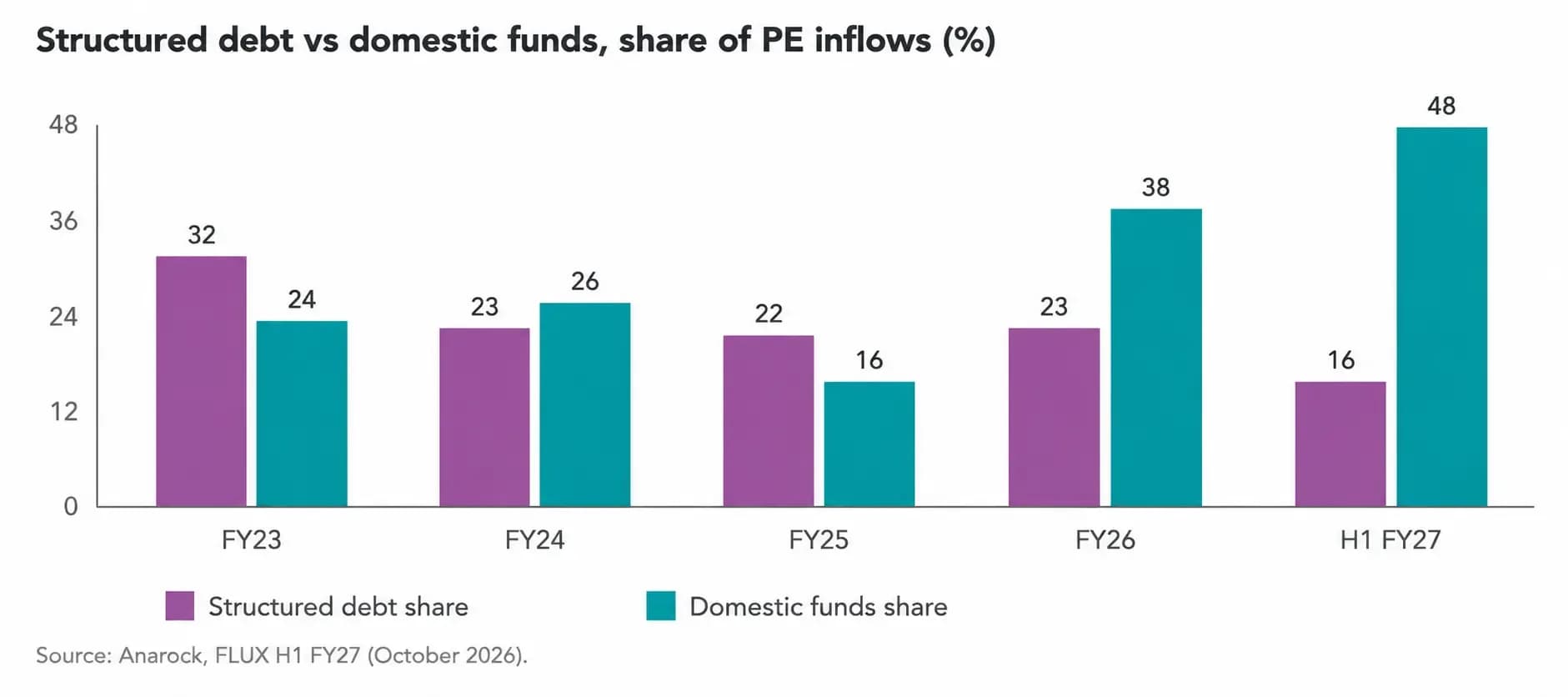
One limit on that chart cuts against the headline. Both bars measure shares of private equity inflows, institutional transaction capital rather than the whole credit market, and the far larger bank and NBFC lending book sits outside the series. Private credit has lost share of institutional dealmaking, not of all real estate lending, and a smaller share of a half in which inflows grew 23% still means more rupees lent, almost all of them into one asset class.
Housing completion is where the credit goes
Residential development in India absorbs more transactions than any other asset class and less money than that count suggests. Housing took 14% of private equity inflows in H1 FY27, down from 17% in FY26, yet accounted for more than half of all deals, and nearly 90% of the capital reaching it arrived as structured debt, mainly small-ticket funding for completion and the revival of stalled projects (FLUX, H1 FY27).
The cheque sizes match: among the ten largest transactions of the half, the debt entries ran from $28 mn to $84 mn against $729 mn for the largest equity deal.
Demand for that money is being created by the market itself. New launches rose 13% year on year in H1 FY27 and exceeded sales by about 15%, while price growth moderated from 17% in FY25 to 7% in FY26 and 3% in the half. A developer building faster than the market absorbs needs completion capital more than an equity partner, and the lender is pricing a delivery risk the slowdown makes sharper.
The template for that lending is a government fund: the Special Window for Affordable and Mid-Income Housing (SWAMIH) is itself a Category II AIF, managed by SBICAP Ventures, and it has completed 58,596 homes from a corpus that began at ₹12,500 crore and reached ₹15,530 crore by December 2022 (Powering the Next Decade, May 2026). Its eligibility rules read like an underwriting checklist, meaning the test a lender applies before pricing a loan: registered under the Real Estate (Regulation and Development) Act, stalled for financial reasons, net-worth positive and at least 30% complete.
SWAMIH 2.0, announced in the Union Budget 2025-26 with a ₹15,000 crore corpus for another 1 lakh units, keeps that shape. What the Anarock investment banking desk sees in mandates of this kind is that the negotiation turns less on the coupon than on those tests, because they decide whether the loan can be refinanced at all.
What capital costs at each project stage
Price in this market tracks where in the build a lender steps in, far more than who the borrower is. Anarock maps the capital lifecycle in seven stages with an indicative annual rate against each, and the rate is highest where approvals, title or completion are uncertain.
| Stage | Indicative rate a year | Who lends |
|---|---|---|
| Entry, before approvals are secured | 18–20% | AIFs only |
| Once approvals are secured | 14–16% | AIFs, banks, HFCs, NBFCs |
| Development, all lender types funding | 9–13% | AIFs, banks, HFCs, NBFCs |
| Completed or near-completion projects | 10–13% | Banks, HFCs, NBFCs |
| Critical intervention, widest lender pool | 16–18% | AIFs, banks, HFCs, NBFCs, asset reconstruction companies |
| Assets requiring turnaround capital | 18–22% | AIFs, primarily |
| Stable, operating asset | 7–9% | Banks and HFCs, almost exclusively |
The distance between the first row of that table and the last, 18-20% against 7-9%, is the margin a borrower is working to capture. Carrying a project from the entry stage to the operating stage converts expensive fund money into cheap bank money, the route the report names for AIF lending: structured refinance into bank debt.
The coupon is therefore only part of the cost, and what sits beside it is how fast the project reaches the condition at which a bank will refinance, because every quarter of delay is charged at the higher rate.
What the 2025 rules do not reach
A rule written to make bank lending safer has made fund lending more necessary. The Reserve Bank of India (Project Finance) Directions, 2025 were issued on 19 June 2025 and took effect on 1 October 2025, harmonising how project loans are sanctioned and provisioned. They set a standard asset provision of 1.25% on commercial real estate exposures during construction against 1.00% once the asset operates, cap the extension of the commercial operations date at two years for non-infrastructure projects, and carry the 75% land requirement described earlier. Each of those raises the cost of holding an unfinished project on a regulated balance sheet, and so pushes the earliest, least certain stages further toward funds.
Which lenders that reaches is worth getting right, and it is commonly reported wrongly. The Directions apply to commercial banks, all NBFCs including HFCs, primary urban co-operative banks and All India Financial Institutions. The last is abbreviated to AIFI and often read as AIF; the two are not the same, and Alternative Investment Funds are not among the entities bound. AIFs answer to SEBI instead, under the SEBI (Alternative Investment Funds) Regulations, 2012, last amended on 14 July 2026. The same project can therefore sit under two rulebooks with different tolerances for an unfinished building, and the spread in Table 2 is what that difference costs a borrower.
How the loan ends is the last thing to settle, and there are now more ways out than there were. A stabilised asset can be refinanced by a bank at 7-9%, sold into a listed trust, or used to seed one: the six listed REITs hold more than 210 mn sq ft against roughly 550 mn sq ft of REIT-eligible office stock, so most of it still needs a route to market (FLUX, H1 FY27). The choice between those routes is set out in the Anarock outlook on REITs in India, and for a single sub-scale building the SM REIT framework sets the thresholds. A lender underwriting a project today is underwriting that exit as much as the asset.
Key takeaways
Two things moved in opposite directions through H1 FY27: the AIF pools grew, and the share of them that lends shrank.
- Domestic AIFs and family offices now supply nearly half of institutional inflows, but mostly as equity buying completed, leased assets, while structured debt has fallen to 16% from 32%.
- The credit that remains sits where regulation keeps banks and NBFCs out: land before approvals, and last-mile housing completion, which took nearly 90% of residential capital in H1 FY27, priced at 18-20% against 7-9% once a bank takes the asset.
- The 2025 project finance rules bind regulated lenders and not AIFs, which preserves that gap. A bank quote and a fund quote for the same project are set under different rulebooks, and part of the difference between them is that regulatory distance rather than a view on the borrower.
Where this sits at Anarock
Anarock Investment Banking advises developers, funds and institutional investors on structured debt, platform transactions and the route from private capital to a listed exit. The investment banking desk publishes FLUX, the capital-flows monitor cited throughout.
Frequently asked questions
What is private credit in Indian real estate?
Private credit is a loan made by a fund rather than a bank, structured against the cash flows of a single project, and in India it is extended almost entirely through Category II Alternative Investment Funds. It is used where regulation or risk appetite keeps banks and NBFCs out: land and approvals, last-mile completion, and stressed assets.
Is private credit growing or shrinking in Indian real estate?
Both, depending on what is measured. Real estate is the largest single destination for AIF money in India, at about 12% of roughly $8 bn invested across all AIF categories to December 2025. Yet structured debt fell to 16% of real estate private equity inflows in H1 FY27 from 32% in FY23, as equity rose to 83% (FLUX, H1 FY27).
What does private credit cost a developer in India?
Cost tracks the project stage rather than the borrower. Anarock puts the indicative rate at 18-20% a year before approvals, where only AIFs lend, 9-13% during development when banks and NBFCs participate, 18-22% for turnaround capital, and 7-9% for a stable operating asset.
How do AIFs compare with banks and NBFCs for funding a project?
Banks are the cheapest and slowest, lend conservatively at 60-70% and refinance stabilised assets most easily. NBFCs are faster and dearer at similar leverage, with a common takeout to banks once the project is registered. AIFs are the most expensive, the fastest for high-risk situations, geared up to 70%, and typically exit through a structured refinance into bank debt.
Do the 2025 RBI project finance rules apply to AIFs?
No. The Directions, issued on 19 June 2025 and effective 1 October 2025, apply to commercial banks, all NBFCs including housing finance companies, primary urban co-operative banks and All India Financial Institutions, abbreviated to AIFI and often misread as AIF. Alternative Investment Funds are regulated by SEBI under the Alternative Investment Funds Regulations, 2012.
How does a private credit lender in real estate get repaid?
Usually by the borrower moving the project to a condition a cheaper lender will accept. The standard route for an AIF loan is a structured refinance into bank debt once the asset is complete and let, at which point the indicative rate drops to 7-9%. A stabilised asset can instead be sold into a listed trust.
Sources
- Anarock, FLUX: Market Monitor for Capital Flows in Indian Real Estate (H1 FY27), October 2026 - inflow totals, the equity and debt mix, domestic and foreign shares, asset-class shares. Author: Ajinkya Magdum, Vice President, Anarock Research and Advisory.
- Anarock Capital, Powering the Next Decade (May 2026) - the lender comparison, stage-wise cost of capital, AIF categories, lending exposure and the SWAMIH funds.
- Reserve Bank of India, Project Finance Directions, 2025, RBI/2025-26/59, 19 June 2025 - applicability, the land requirement and provisioning.
- Securities and Exchange Board of India, SEBI (Alternative Investment Funds) Regulations, 2012, last amended on 14 July 2026.
- Anarock, REITs in India: institutional outlook (2026).
- Anarock, SM REIT framework for asset owners.