
13 Min Read
25 November 2026Industrial and logistics real estate in India: What is driving institutional demand in 2026
Share
Table of Contents+
TL;DR
- Warehousing stock across the top eight Tier-I cities has nearly doubled in four years, from 294 mn sq ft in 2021 to 493 mn sq ft in 2025, and is projected to reach 750 mn sq ft by 2028, making it one of the fastest-growing real estate asset classes in India.
- The market is formalising toward institutional quality. Grade A stock has compounded at about 20% a year since 2021, more than twice the roughly 8% pace of Grade B, and Grade A now accounts for 59% of total absorption, up from 55% a year earlier.
- Demand is structural rather than cyclical, led by third-party logistics and e-commerce operators on the storage side and by auto and engineering firms on the light-manufacturing side, and supported by the broader shift of global sourcing toward India.
- Capital is following the demand. Private equity invested about $4.3 bn in Indian real estate across 60 deals in FY26, with industrial and logistics among the largest recipients, and inflows continued into H1 FY27 at about $2.7 bn, up 23% year-on-year.
- The near-term picture is more mixed. New supply outran net absorption in H1 2026 for the first time in several years, 42.7 mn sq ft against 34.8 mn sq ft, and the 2026 conflict softened export-linked demand even as domestic e-commerce demand held firm.
Introduction
A warehouse in India was once a low-grade shed on the edge of a city, built to store goods and little else. That has changed. Modern logistics parks are now one of the fastest-growing institutional asset classes in Indian real estate, and the capital backing them underwrites a Grade A warehouse much as it would an office building, on lease quality, tenant covenant and yield. The shift matters because it changes what an investor is buying: not a commodity shed, but a long-lease, income-producing asset tied to the growth of organised retail and manufacturing.
The scale of that change is what this piece sets out. Warehousing stock has nearly doubled in four years and is still climbing, the stock is formalising toward institutional grade, and private equity is concentrating in the sector. This analysis takes the 2026 data in three parts: how fast the asset class is growing, what is driving the demand behind it, and what the current cycle, with supply running ahead and a war reshaping trade, complicates in the near term.
The fastest-growing asset class in Indian real estate
Few parts of Indian real estate have grown as quickly, or as consistently, as warehousing over the past five years. The expansion has been large enough to change the asset class from a fragmented, local business into one that institutions can hold at scale, and the pace shows little sign of easing.
Stock has nearly doubled and keeps climbing
The clearest measure of that growth is the stock itself. Warehousing stock across the top eight Tier-I cities rose from 294 mn sq ft in 2021 to 493 mn sq ft in 2025 and is projected to reach 750 mn sq ft by 2028. That is close to a doubling in four years, with another half again to come over the following three, a trajectory few other asset classes in India can match. The growth has also been durable through a run of macro shocks, which is part of why it reads as structural rather than a single cycle.
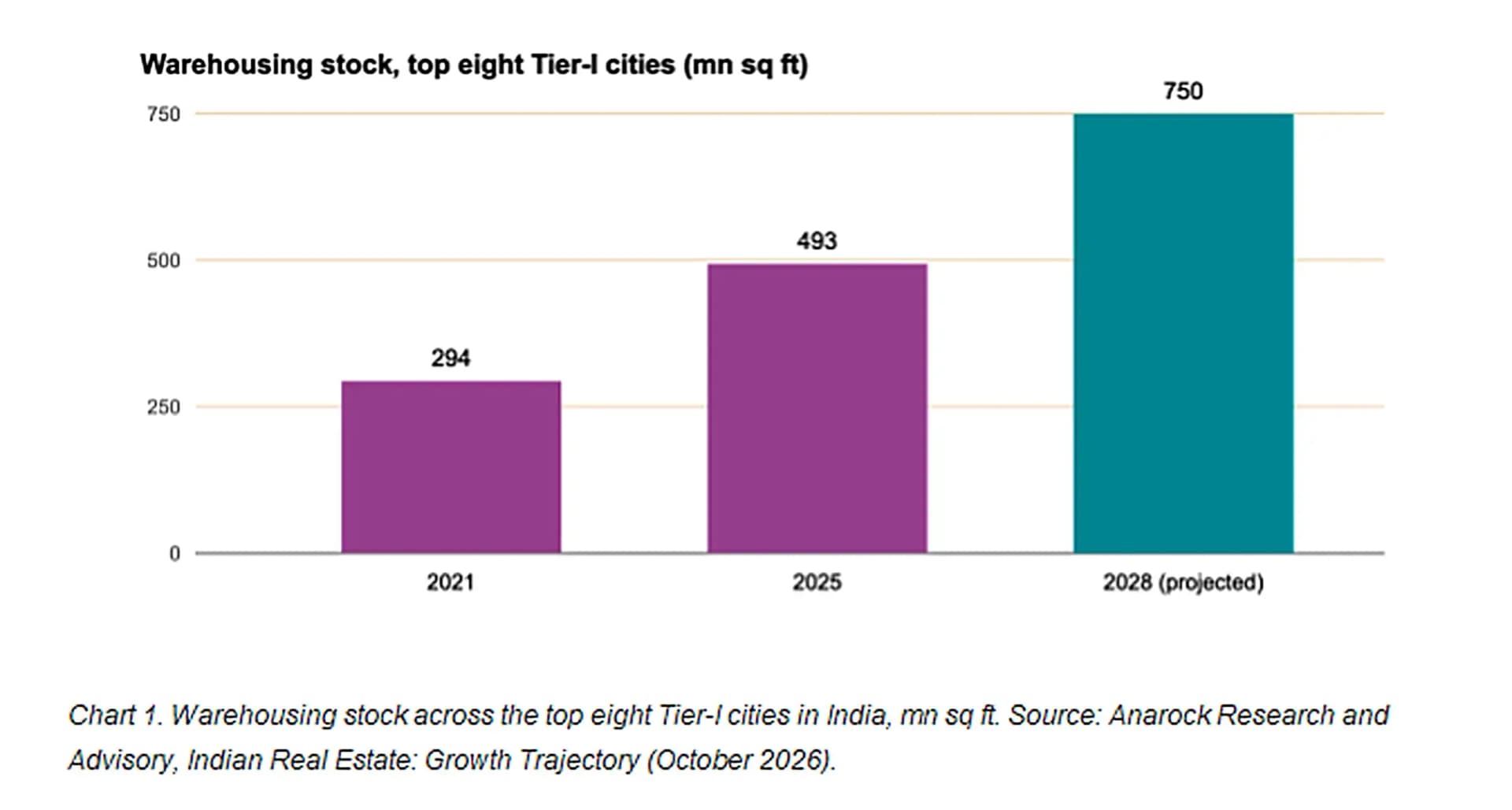
A build of that size, sustained across several years of macro shocks, is what moves an asset class from a fragmented local business into one institutions can own at scale. How much of it is institutional-grade is the next question.
The market is formalising toward Grade A
Just as important as the pace is the mix. Grade A stock has compounded at about 20% a year since 2021, more than twice the roughly 8% pace of Grade B, where Grade A means the modern, institutionally specified warehousing that funds will hold. That shift shows up in take-up as well as supply: Grade A now accounts for 59% of total absorption across the top eight cities, up from 55% a year earlier. For an investor, the practical meaning is that a growing share of the market is now reaching the specification, lease structure and tenant quality that institutional capital requires, which is what has turned warehousing from a developer-and-operator business into an ownable asset class.
What is driving institutional demand
Rapid growth only draws institutional capital if the demand behind it is durable. In warehousing, it rests on a handful of structural shifts in how goods are stored, moved and made, and those shifts are what give an underwriter confidence that today's occupancy will still be there in a decade.
E-commerce, logistics and the manufacturing shift
Demand comes from two broad occupier groups. On the storage side, third-party logistics and e-commerce operators account for the majority of take-up, as organised retail and online shopping increasingly push companies to hold more inventory closer to customers and to expand their networks beyond the largest metros. On the light-manufacturing side, auto and ancillary firms lead, with engineering and electronics close behind, as production and assembly scale up. Underpinning both is the broader shift of global sourcing toward India, often described as China-plus-one, which is adding export-oriented manufacturing and the logistics that serve it. Because these are tied to long-run consumption and industrial trends rather than to a single rate cycle, the report reads the demand as structural, which is exactly the quality an institution underwriting a 10-year lease is looking for.
Capital is following the demand
Investment flows have tracked that conviction. Private equity put about $4.3 bn into Indian real estate across 60 deals in FY26, a 46% rise in deal count over the 41 deals of FY25, and industrial and logistics assets were among the largest recipients of that funding alongside office. The flow continued into the first half of FY27, when private equity inflows rose 23% year-on-year to about $2.7 bn across 30 deals, with the average deal size up 18% to about $91 mn. That capital is also entering a sector whose balance sheets are unusually strong: the aggregate net debt-to-equity ratio of listed developers has fallen from a peak of 0.55 times in FY17 to just 0.05 times in FY26, which gives the sector room to fund construction through a period of higher costs.
| Period | PE invested | Deals | Note |
|---|---|---|---|
| FY26 (full year) | About $4.3 bn | 60 | Industrial and logistics among the largest recipients, with office |
| H1 FY27 | About $2.7 bn | 30 | Up 23% year-on-year; average deal size about $91 mn |
Rising allocations into a sector that carries little debt give capital room to fund the growth directly. What that capital still has to price is a near-term cycle that has looked less smooth than the long-run trend.
What the 2026 cycle complicates
The structural case is strong, but 2026 has added two near-term complications that an investor has to price. Neither changes the long-run trajectory, but both affect the returns realised over the next few years, and the honest read of the sector has to hold them alongside the growth story.
Supply has run ahead of absorption
For the first time in several years, developers added space faster than the market absorbed it. New supply reached 42.7 mn sq ft in H1 2026 against net absorption of 34.8 mn sq ft across the top eight cities, a reversal from the tight supply-demand balance of recent years. The imbalance is concentrated in the largest markets, with Tier 1 cities accounting for 86% of supply and 78% of absorption, while Tier 2 and 3 markets gradually gain share as logistics networks extend beyond the metros. For developers and investors, the near-term signal is that the pricing power of the past few years may ease where new completions are heaviest, even as the longer-run demand case holds.
| Measure | H1 2026 |
|---|---|
| New supply | 42.7 mn sq ft |
| Net absorption | 34.8 mn sq ft |
| Grade A share of absorption | 59% (up from 55% a year earlier) |
| Tier 1 share of supply | 86% |
| Tier 1 share of absorption | 78% |
Geopolitics has split demand and lifted costs
The second complication is the 2026 conflict between the United States, Israel and Iran, which began in February and pushed Brent crude from about $70 a barrel in January to nearly $110 by September. That has worked through the sector in two ways. It has raised the cost of building, with total construction costs up an estimated 8-10% and the sharpest increases in fuel and site-logistics costs, up 15-20%, and in steel, up about 20%. And it has split the demand: the export-oriented, manufacturing-linked part of warehousing demand has softened as global trade slows, while the domestic, e-commerce-linked part and the China-plus-one sourcing shift have stayed structurally intact. As the report itself notes, industrial and warehousing is among the asset classes most directly exposed to global trade, which is why this split matters more here than in a purely domestic sector.
Key takeaways
The 2026 data describes an asset class that has earned institutional attention, with a durable demand base and two near-term frictions to weigh against it.
- Warehousing is the standout growth story, with stock across the top eight cities rising from 294 mn sq ft in 2021 to a projected 750 mn sq ft by 2028 and Grade A compounding at about 20% a year.
- The market is formalising, with Grade A now 59% of absorption, which is what makes the asset class ownable for institutions rather than only for operators.
- The demand is structural, resting on e-commerce, third-party logistics and a manufacturing shift toward India, so it is tied to long-run consumption and industrial trends rather than to a single rate cycle.
- Capital has followed, with private equity putting about $4.3 bn into Indian real estate in FY26 and industrial and logistics among the largest recipients, backed by developer balance sheets at their strongest in over a decade.
- The near-term frictions are a supply overshoot, with 42.7 mn sq ft of new space against 34.8 mn sq ft absorbed in H1 2026, and a 2026 conflict that has lifted construction costs and softened export-linked demand.
Where this sits at Anarock
The industrial and logistics advisory practice at Anarock advises occupiers, developers and institutional investors on warehousing and industrial real estate across India, from site selection and leasing to investment and portfolio strategy, drawing on the same first-party data behind this analysis. For related reading, see the Anarock coverage of how GCCs and data centres are redrawing the real estate map in India and of Tier 2 and 3 cities as growth engines.
Sources
- Anarock Research and Advisory, Indian Real Estate: Growth Trajectory, Sectoral Outlook and Geopolitical Crosscurrents (October 2026); warehousing stock, supply, absorption, Grade A mix, occupier types, construction-cost escalation and private equity flows.
- Anarock Investment Banking, Anarock IB FLUX, H1 FY27; private equity inflows, deal count and average deal size.
- Anarock, Industrial and logistics advisory service.
- Anarock, GCCs and data centres are redrawing the real estate map in India.
- Anarock, Tier 2 and 3 cities are rapidly becoming growth engines for Indian real estate.
Frequently asked questions
Why is industrial and logistics real estate growing in India?
Warehousing has become one of the fastest-growing real estate asset classes in India, with stock across the top eight Tier-I cities rising from 294 mn sq ft in 2021 to 493 mn sq ft in 2025 and projected to reach 750 mn sq ft by 2028. The growth is led by structural demand from e-commerce, third-party logistics and a manufacturing shift toward India, and it is drawing institutional capital as the stock formalises toward Grade A.
How big is the warehousing market in India?
Warehousing stock across the top eight Tier-I cities reached about 493 mn sq ft in 2025, up from 294 mn sq ft in 2021, and is projected to reach 750 mn sq ft by 2028 (Anarock, Indian Real Estate: Growth Trajectory, October 2026). Within that, Grade A stock has compounded at about 20% a year, more than twice the roughly 8% pace of Grade B, so modern, institutionally specified space is a rising share of the total.
What is driving warehousing demand in India?
Demand comes from two occupier groups. On the storage side, third-party logistics and e-commerce operators account for the majority of take-up as organised retail and online shopping expand. On the light-manufacturing side, auto and ancillary firms lead, with engineering and electronics close behind. Underpinning both is the broader China-plus-one shift of global sourcing toward India, which adds export-oriented manufacturing and the logistics that serve it.
Is warehousing supply outpacing demand in 2026?
In the short term, yes. New supply reached 42.7 mn sq ft in H1 2026 against net absorption of 34.8 mn sq ft across the top eight cities, the first time in several years that supply outran absorption. The imbalance is concentrated in the largest markets, with Tier 1 cities taking 86% of supply and 78% of absorption, so pricing power may ease where completions are heaviest even as the longer-run demand case holds.
Is institutional capital investing in Indian industrial real estate?
Yes. Private equity invested about $4.3 bn in Indian real estate across 60 deals in FY26, with industrial and logistics assets among the largest recipients alongside office, and inflows continued into H1 FY27 at about $2.7 bn across 30 deals, up 23% year-on-year. The sector is also unusually well-capitalised, with the aggregate net debt-to-equity ratio of listed developers down from 0.55 times in FY17 to 0.05 times in FY26.
How has geopolitics affected industrial real estate in India?
The 2026 conflict between the United States, Israel and Iran pushed Brent crude from about $70 a barrel in January to nearly $110 by September, raising total construction costs an estimated 8-10%, with fuel and site-logistics costs up 15-20% and steel up about 20%. It has also split demand: export-oriented, manufacturing-linked warehousing demand has softened as trade slows, while domestic e-commerce demand and the China-plus-one shift have stayed intact.
What is Grade A warehousing and why does it matter?
Grade A warehousing is modern, institutionally specified stock with the clear height, floor loading, dock access and lease structure that institutional investors require. It matters because it is the part of the market funds will own, and it is growing fastest: Grade A stock has compounded at about 20% a year since 2021 and now accounts for 59% of total absorption, up from 55% a year earlier, a sign of the market formalising toward institutional quality.
Where is warehousing demand concentrated in India?
Demand remains concentrated in the largest markets, with Tier 1 cities accounting for 86% of new supply and 78% of absorption across the top eight Tier-I cities in H1 2026. Tier 2 and 3 markets are gradually gaining share, however, as e-commerce and third-party logistics operators extend their networks beyond the metros to hold inventory closer to a wider base of customers.