
14 Min Read
19 November 2026Panvel, Navi Mumbai: prices up 76% on an infrastructure build-out
Share
Table of Contents+
TL;DR
- Residential prices in Panvel appreciated 76% from 2021 to the first half of 2026, the average basic selling price stands at ₹14,935 per sq ft, and its price index of 176 is ahead of 164 for Navi Mumbai, a corridor outpacing its parent market (Micro Market Report - Panvel, Navi Mumbai, MMR, August 2026).
- The driver is infrastructure: ₹2.4 lakh crore of capital deployed across the nine projects in and around the catchment listed in Table 1, among them the now-operational NMIA, the Atal Setu sea link, the metro network and the Panvel-Karjat rail corridor, with Panvel about 14-15 minutes from the airport.
- Supply scaled quickly, with 42,330 units launched over 2021 to the first half of 2026 and the Panvel share of Navi Mumbai supply rising from 28% in 2021 to 46% in 2024, then moderating to 42% in 2025 and 24% in H1 2026.
- The market is mid-income and demand-led: 1 BHK homes are 43% of supply and 2 BHK 42%, and the ₹50 lakh to ₹1 crore band accounts for 47% of launches.
- 91% of available inventory is under construction, which Anarock reads as developer confidence in future demand. Delays to major infrastructure are named separately as a threat to demand and appreciation.
Introduction
Until a few years ago, Panvel was just a railway junction that most capital crossed on the way to a Mumbai address priced several times higher. Presently, what has changed is that the airport it adjoins is now operational, and the land around it is being built out as a growth node rather than a place to pass through. For an investor, a developer or a large buyer, the open question is not growth but delivery. Does the build-out behind the price rise arrive on the schedule that prices already assume?
The re-rating runs on infrastructure: an operational airport, ₹2.4 lakh crore of capital deployed across the catchment, and a price index that has pulled ahead of Navi Mumbai. Against that, 91% of the inventory available to buy is still under construction, and delays to major infrastructure are a named threat to both demand and expected appreciation.
Why institutional capital is looking at Panvel
The case for Panvel rests on two things: a location at the junction of four markets, and ₹2.4 lakh crore of infrastructure capital deployed across the catchment.
The location and the Mumbai 3.0 corridor
Panvel sits where four markets meet: Mumbai, Navi Mumbai, Pune and the Konkan region. That intersection is the root of the investment case. It is why Mumbai 3.0, the growth plan of the Maharashtra Government, treats Panvel as one of the region's next growth centres rather than an outlying suburb. The node is anchored by the airport, a proposed aerocity, multimodal transport and port-led industry.
The land has moved ahead of the build-out: more than 6,400 acres were transacted across the Panvel catchment over the five years to 2026 (compiled by Anarock Research and Advisory from various sources). Airport-linked employment in aviation, logistics and hospitality is beginning to add to commuter demand. FedEx has broken ground on an automated cargo hub at NMIA, an early sign those jobs are arriving.
The infrastructure spend behind it
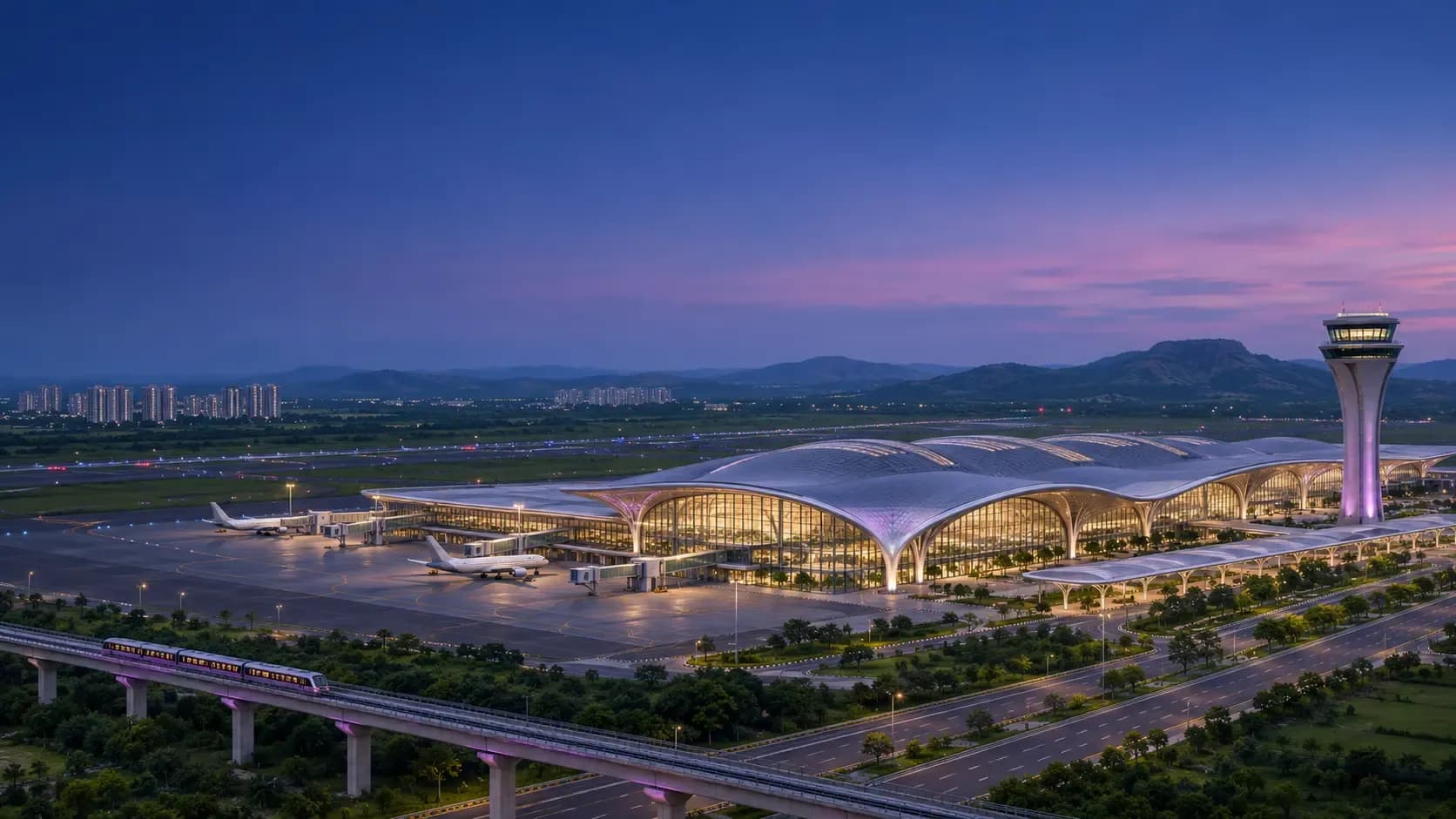
The first driver behind the corridor's outperformance has already arrived: NMIA is operational, placing Panvel roughly 14-15 minutes from a working international gateway, alongside the Atal Setu, investment in metro connectivity, the Panvel-Karjat suburban rail corridor and the proposed 667-acre aerocity. Behind them sits ₹2.4 lakh crore of infrastructure capital deployed in and around the Panvel catchment, across over 1,625 km of road and rail delivered or under construction. The two largest lines in Table 1 are worth separating out: the Delhi-Mumbai Expressway and the Alibaug-Virar corridor are national projects Panvel sits on, not spend committed to Panvel alone.
| Project | Length | Cost (₹ crore) |
|---|---|---|
| Delhi-Mumbai Expressway | 1,350 km | 1,00,000 |
| Alibaug-Virar Multimodal Corridor | 126 km | ~59,600 |
| Navi Mumbai International Airport (NMIA) | - | ~20,000 |
| MTHL (Atal Setu) | 22 km | 17,843 |
| Mumbai Metro Line 5 (Thane-Bhiwandi-Taloja) | 47.1 km | 16,832 |
| Mumbai Metro Line 8 (CSMI Airport Terminal 2 to NMIA) | 35 km | 15,000 |
| Navi Mumbai Metro Line 2 (Taloja-Kharkopar) | 8.15 km | 5,575 |
| Navi Mumbai Metro Line 1 (Belapur-Pendhar) | 11.1 km | 4,070 |
| Panvel-Karjat Rail Corridor | 29.6 km | ~2,782 |
What the data shows
Prices have risen faster than in Navi Mumbai as a whole, supply has followed and then fallen back, and the stock on the market is almost entirely unbuilt.
Prices, appreciation and the Navi Mumbai comparison
The move that matters is the one against Navi Mumbai. Prices in Panvel appreciated 76% between 2021 and the first half of 2026, and the average basic selling price stands at ₹14,935 per sq ft on carpet area as of H1 2026. Indexed to 100 in 2021, Panvel reached 176 by H1 2026 against 164 for Navi Mumbai, a faster climb than the market it belongs to.
That outperformance comes primarily from the transformation of Panvel into an infrastructure-led growth corridor: the operational NMIA, the Atal Setu, metro connectivity, the Panvel-Karjat rail corridor and the proposed aerocity. Both indices are rebased to 100 in 2021, so the gap compares growth rates, not price levels. Panvel remains a more affordable entry point than Mumbai and the established parts of Navi Mumbai.
Supply, configuration and inventory
Developers moved on that gap quickly, and have since pulled back from it. They launched 42,330 units in Panvel between 2021 and the first half of 2026. Over the same period the corridor's share of all residential supply in Navi Mumbai rose from 28% in 2021 to 46% in 2024, then moderated to 42% in 2025 and 24% in H1 2026. The concentration peaked in 2024, when close to half of everything launched across Navi Mumbai was in Panvel; the H1 2026 share is the lowest in the series.
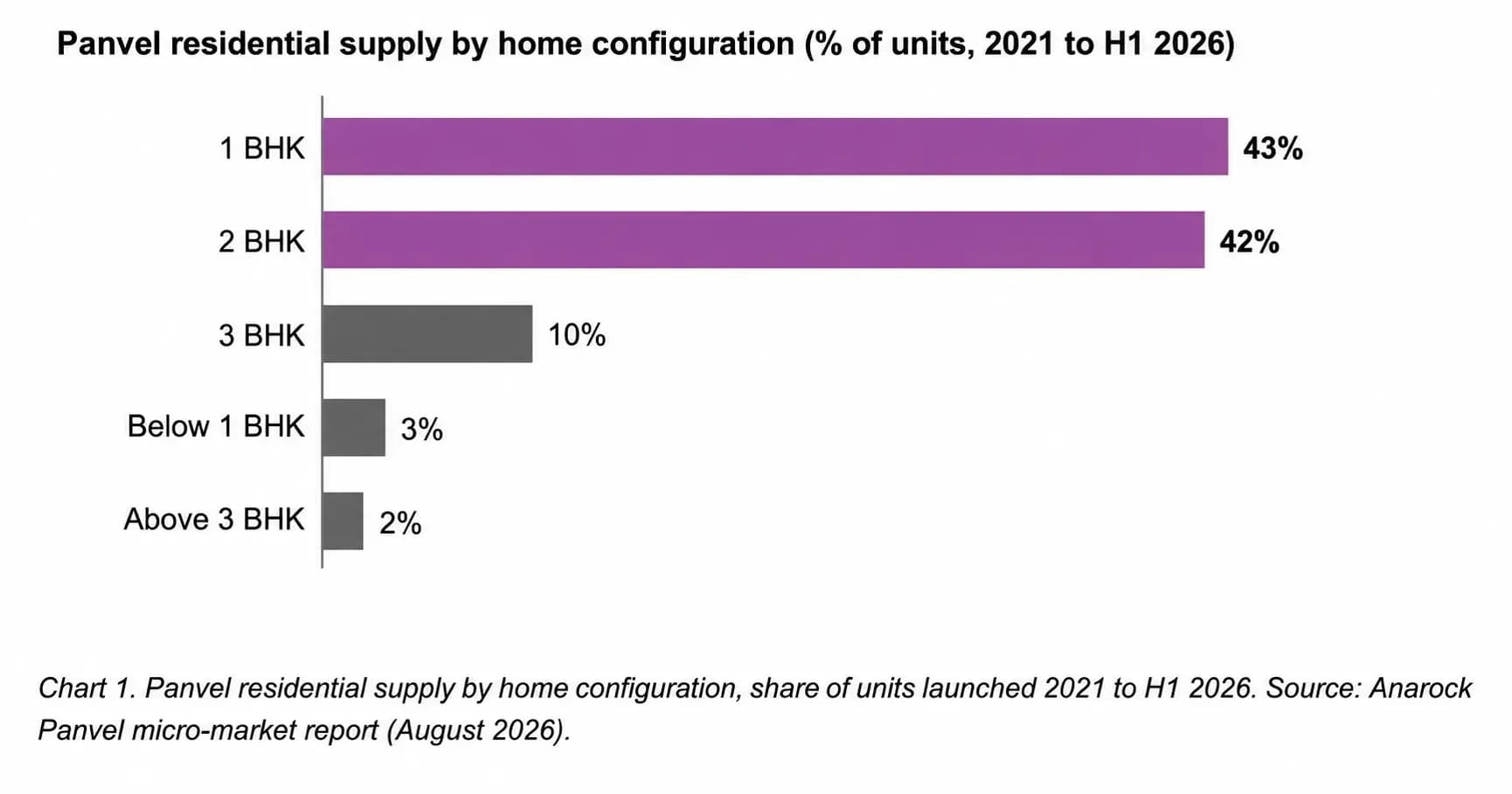
What they are building is a narrow, demand-led product: 1 BHK homes are 43% of supply and 2 BHK 42% (Chart 1), 3 BHK only 10%, with little premium depth. The ₹50 lakh to ₹1 crore budget band accounts for 47% of launches, placing Panvel as a mid-income market built for first-time buyers and smaller investors.
The stock on the market is almost entirely unbuilt. As of the first half of 2026, 91% of available inventory was under construction and only 9% ready to move in. Anarock reads that as developer confidence in future demand. It also puts the completion schedule at the centre of the outcome, with delays to major infrastructure a named threat to both demand and expected appreciation.
What a home costs to buy, and what it rents for
The homes behind those completion dates are compact, and priced below both Mumbai and the established parts of Navi Mumbai (Table 2).
| Configuration | Avg. size range | Ticket price | Monthly rent |
|---|---|---|---|
| 1 BHK | 350-550 sq ft | ₹52-82 lakh | ₹13,000-18,000 |
| 2 BHK | 550-750 sq ft | ₹82 lakh - ₹1.12 crore | ₹20,000-25,000 |
| 3 BHK | 750-1,050 sq ft | ₹1.12-1.56 crore | ₹30,000-35,000 |
Those averages put the bulk of the market in the ₹50 lakh to ₹1 crore band, which covers 47% of everything launched since 2021. It is also the band most exposed to the land prices now rising through the corridor.
The risks an allocator has to price
Those land prices are one of four weaknesses Anarock sets against the corridor, and the four that matter to a buyer all move either the entry price or the holding period.
Delivery is the one with most riding on it. With almost all of the available stock under construction, the outcome depends on developers completing on schedule, and delays to major infrastructure are a named threat to both residential demand and expected appreciation.
Affordability is the second. The same infrastructure-led development that lifted values is raising residential land prices, and with them the entry price that drew buyers to Panvel in the first place.
Third is friction on the ground: traffic congestion around Panvel, Kalamboli and the major junctions at peak hours, and lengthy approvals where environmental and Coastal Regulation Zone (CRZ) rules apply. Limited premium retail and entertainment infrastructure also narrows the appeal of the corridor for some buyers.
Fourth is competition from other well-connected micro-markets opening up across MMR. Alongside it sit macroeconomic uncertainty, financing conditions and affordability constraints, any of which could moderate residential demand and slow the pace of new launches.
Four things sit on the other side. NMIA and metro connectivity are expected to enhance residential demand and support long-term capital appreciation. The residential developments and supporting social infrastructure planned by CIDCO are expected to expand the housing ecosystem and draw new homebuyers. Migration out of Mumbai for more affordable, better-connected housing is expected to continue. And commercial, IT and logistics hubs around Navi Mumbai are expected to generate further housing demand. Three of the four turn on the same infrastructure whose delay is the principal risk.
What comes next for the corridor
The next phase is already defined by what is being built around the airport. A 667-acre aerocity is proposed around NMIA to turn Panvel into a commercial hub rather than a dormitory. That is the development most likely to change the corridor's employment base. Around it sit the Panvel-Karjat rail corridor, an integrated logistics park by CIDCO, and integrated townships that bring residential, commercial and mixed-use supply to market together.
The Anarock outlook is that Panvel becomes one of the primary beneficiaries of Mumbai 3.0 as that ecosystem takes shape. What is being taken on trust is the schedule. The aerocity is proposed, the logistics park planned, and the metro and rail corridors still under construction. A buyer who can hold to those completion dates carries a different risk from one who needs an exit before them.
Key takeaways
Panvel holds two facts at once: prices have re-rated on infrastructure that is partly delivered, and 91% of the inventory available to buy is not yet built.
- The appreciation is ahead of the parent market: prices up 76% over 2021 to H1 2026, an average basic selling price of ₹14,935 per sq ft, and a price index of 176 against 164 for Navi Mumbai. Both indices are rebased to 100 in 2021, so this is a comparison of growth rates, not of price levels.
- The case rests on infrastructure that is partly delivered and partly promised: NMIA is operational, but the metro lines, rail corridor and aerocity that complete the thesis are still being built, and the timeline is the main variable.
- The corridor is a mid-income, 1 and 2 BHK market: the ₹50 lakh to ₹1 crore band is 47% of launches over 2021 to H1 2026, and 1 BHK homes are 43% of supply and 2 BHK 42%.
- Delivery is where the risk concentrates: with 91% of available inventory under construction, completion and timing decide the outcome, and infrastructure delay is a named threat to demand and appreciation alike.
Where this sits at Anarock
Anarock Research and Advisory produces micro-market reports of this kind across the Mumbai Metropolitan Region and the rest of India, pairing launch, price and inventory data with the context needed to read a corridor.
Frequently asked questions
Is Panvel a good place to invest in real estate in 2026?
Panvel has re-rated on infrastructure. Prices appreciated 76% between 2021 and the first half of 2026, the average basic selling price stands at ₹14,935 per sq ft, and the corridor's price index of 176 is ahead of 164 for Navi Mumbai (Anarock, August 2026). The main consideration is delivery: 91% of available inventory is under construction, so the outcome depends on developers and infrastructure arriving on schedule.
How much have Panvel property prices risen?
Panvel prices appreciated 76% between 2021 and the first half of 2026, and the average basic selling price stands at ₹14,935 per sq ft on carpet area as of H1 2026. Indexed to 100 in 2021, Panvel reached 176 by H1 2026 against 164 for Navi Mumbai as a whole, a faster climb than its parent market (Anarock, Panvel micro-market report, August 2026).
How has the Navi Mumbai International Airport affected Panvel real estate?
NMIA is operational and places Panvel about 14-15 minutes from a working international gateway. It is the first of the drivers behind the outperformance of the corridor, alongside the Atal Setu, metro connectivity, the Panvel-Karjat rail corridor and the proposed aerocity. It sits within ₹2.4 lakh crore of infrastructure capital deployed across the catchment, and airport-linked jobs in aviation, logistics and hospitality are beginning to add to existing demand, with FedEx breaking ground on an automated cargo hub at the airport.
What is the typical ticket size for a home in Panvel?
Panvel is a mid-income market concentrated in compact homes. Average ticket prices are ₹52 lakh to ₹82 lakh for a 1 BHK of 350 to 550 sq ft, ₹82 lakh to ₹1.12 crore for a 2 BHK of 550 to 750 sq ft, and ₹1.12 crore to ₹1.56 crore for a 3 BHK of 750 to 1,050 sq ft. The ₹50 lakh to ₹1 crore band accounts for 47% of launches over 2021 to H1 2026, and 1 BHK homes are 43% of supply and 2 BHK 42%.
What does a home in Panvel cost to buy or rent?
Figures are averages by configuration. A 2 BHK of 550 to 750 sq ft carries an average ticket price of ₹82 lakh to ₹1.12 crore and an average monthly rent of ₹20,000 to ₹25,000. A 1 BHK of 350 to 550 sq ft is ₹52 lakh to ₹82 lakh with an average monthly rent of ₹13,000 to ₹18,000, and a 3 BHK of 750 to 1,050 sq ft is ₹1.12 crore to ₹1.56 crore with an average monthly rent of ₹30,000 to ₹35,000.
What are the main risks of investing in Panvel?
Delivery has most riding on it: 91% of available inventory is under construction, so the outcome depends on developers and the supporting metro and rail lines arriving on time, and infrastructure delay is a named threat to demand and appreciation. Anarock also lists rising land prices reducing affordability, traffic congestion around Panvel and Kalamboli, lengthy approvals where environmental and Coastal Regulation Zone rules apply, limited premium retail and entertainment infrastructure, competition from other well-connected MMR micro-markets, and macroeconomic and financing conditions that could moderate demand.
What is Mumbai 3.0 and how does Panvel fit into it?
Mumbai 3.0 is the plan of the Maharashtra Government to widen the economic base of the Mumbai Metropolitan Region through new growth corridors, infrastructure and integrated urban centres. Panvel is treated as one of its primary residential and commercial growth centres, anchored by NMIA, a proposed 667-acre aerocity, multimodal transport and port-led industry. More than 6,400 acres of land were transacted across the catchment over the five years to 2026.
Sources
- Anarock Research and Advisory, Micro Market Report: Panvel, Navi Mumbai, MMR (August 2026) - land transacted, prices and the 76% appreciation, the Navi Mumbai price index, supply and configuration, inventory, typology and rents, the infrastructure projects and the strategic outlook. Authors: Sumeet Singh Negi, Vice President, Research and Advisory, and Kushal Vilas Datrange; desk head Dr Prashant Thakur.
- Anarock, Kolkata residential market: building momentum for the next phase of growth - wider residential market context.