
10 Min Read
07 October 2026Mall leasing trends in India: 2026 outlook
Share
Table of Contents+
Introduction
The best malls in India have quietly become one of the hardest kinds of space to lease. A decade ago the format looked exposed, with new centres opening faster than shoppers could fill them and online shopping widely expected to hollow them out. Instead, the strongest centres filled up and stayed full while weaker ones fell behind, and that split is now the whole story of the market.
The Anarock Leasing Trends in Malls report, published in May 2026 with IMAGES Group, puts a size on that split: a stabilised prime opportunity for institutional buyers worth $25-30 bn. With almost nothing left to buy in the prime tier, it maps the only other way to own the same scarce income, which is to take a weaker mall and lift it up into that tier.
A landlord's market meets its first real test
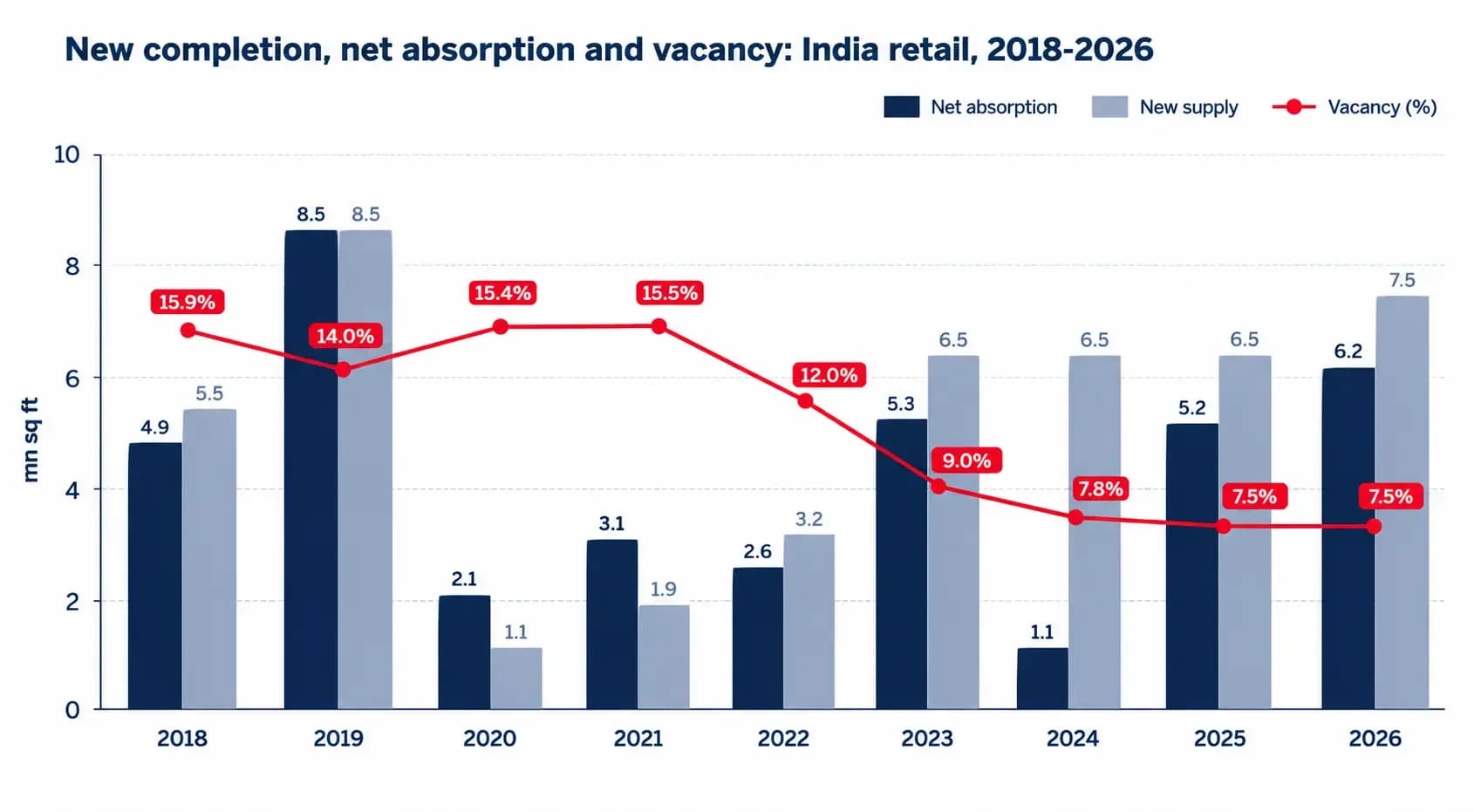
Four straight years of demand outrunning new supply turned malls in India into a landlord's market, and in 2026 that market met its first real test. For the first time since 2021, developers delivered more space than tenants took up: 7.6 mn sq ft of completions against 6.3 mn sq ft of net absorption, the space tenants occupy less what they vacate. That scarcity is how prime malls came to have almost nothing left to let, and how prime rents came to grow 6-10% a year. The wider market tells the same story more slowly: national mall vacancy fell from 15% in 2018 to 7.5% in 2025, before edging up to about 8.5% in 2026 as this new space arrived. Even so, landlords still hold the upper hand, and in the best centres a retailer that wants a store mostly waits for an existing tenant to leave. For an investor, the supply bump has not reached the prime tier, where near-zero vacancy and the pricing power that rests on it are intact. Whether the fresh space loosens the wider market or barely dents it comes down to grade, and to how much of each city's stock already sits in the top tier.
Grade, not size or price, marks the prime tier
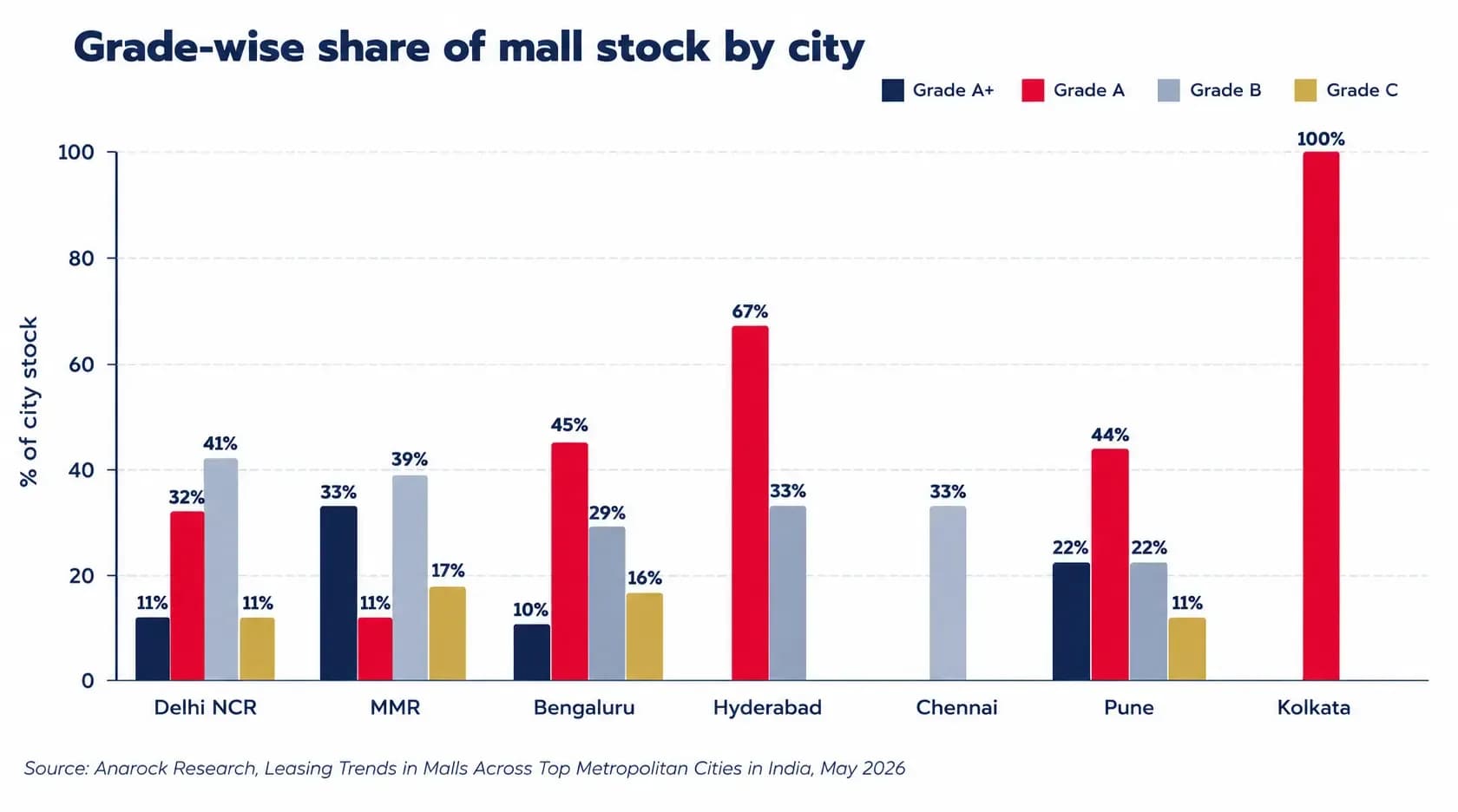
What decides whether a mall sits in the scarce, fully-let tier is its grade, not the city it is in or the rent it charges. In Chennai, every investment-grade mall is Grade A, on 4.6 mn sq ft, so the whole market is a scarcity play. The National Capital Region (NCR) around Delhi is more than four times the size at 19.99 mn sq ft, yet holds 58% of its stock in the weaker Grade B and C, which makes it a stock-picking market where most assets need work before they earn a prime rent. Price does not sort the two apart either: a standard shop runs ₹400-450 per sq ft a month in NCR and the Mumbai Metropolitan Region (MMR) against ₹200-250 in Bengaluru, and benchmarked malls in MMR span ₹332 to ₹777 even though much of the stock around them is second-grade. Rent growth splits by grade as well: the top Grade A+ malls in NCR saw 8-12% appreciation against 6-8% for Grade A, while recently signed leases in MMR ran 15-20% higher year on year. But grade is only the shell, and what fills that shell, and what shoppers now come for, has been shifting just as fast.
What shoppers come for has shifted
The mix of tenants inside a mall has tilted toward experience, and the categories that now draw the crowds are not the ones that pay the most rent. Food, drink and entertainment climbed from about 20% of leasing in 2020 to a projected 33% in 2026, while department stores and hypermarkets slipped from 14% to 3% as online shopping took the categories they used to fill. But that shift carries a catch for the rent roll, because the categories that pull the crowds pay the least per sq ft. Entertainment averages about ₹130 per sq ft a month and food and beverage ₹238, well below the ₹295 to ₹424 that fashion, beauty and jewellery command, as the table sets out. Increasingly, that rent moves with a store's sales rather than sitting fixed in the lease.
| Retail category | Average rent (₹ per sq ft a month) |
|---|---|
| Jewellery, watches and luxury | 424 |
| Beauty and personal care | 419 |
| Fashion and apparel | 295 |
| Food and beverage | 238 |
| Entertainment | 130 |
Income that behaves like an institutional asset
A mall's rent now rises and falls with how well its tenants trade. Most leases pay the higher of a fixed floor or a share of turnover: in the report sample, 74.2% run on that hybrid and most of the rest, 21.7%, are pure rent. The revenue shares themselves are mostly modest, with 55.8% set at 10-15% of sales, and the terms are built for stability, with 62.1% running three to five years and another 33.3% five to seven, and roughly 69% carrying a one-to-three-year lock-in that holds a tenant in place while a centre finds its feet. On the retail mandates we advise, it is that revenue share, not the headline rent, that buyers look at hardest, because it moves with a mall's real footfall rather than a signed number, and it is what lets an owner earn more as its tenants trade better. That combination, near-full occupancy plus income that tracks sales, is what real estate investment trusts (REITs) and other institutional buyers now treat as core holdings. The near-zero vacancy behind the case, though, sits only in the best malls; even the 8.5% wider-market average flatters what a buyer would actually find below the prime tier.
The weaker stock is the far end of the same opportunity
An investor priced out of the near-zero-vacancy prime tier has one other way to buy into the same demand: the ageing Grade B and C stock the report puts at 40-50 mn sq ft, which has fallen behind on layout, tenant mix and management. The return here does not come from owning a scarce, fully-let building but from repositioning a tired one, filling it with the experience categories that now draw footfall and lifting it up a grade until it earns a prime rent. It is more work and more risk than owning a stabilised Grade A mall outright, but the reward is more durable: because the report expects new supply to stay measured and skewed to suburban corridors, the value that repositioning creates is less likely to be competed away by a wave of new building. The weaker stock, then, is the far end of the same opportunity the prime tier anchors, not a separate one, and the desk expects the demand under it to hold through the decade.
Outlook to 2030
Put together, near-zero prime vacancy and sales-linked rent are what draw institutional money to Indian malls, and the report expects both to hold to 2030:
- Stabilised Grade A malls should keep drawing REIT and institutional capital, with the report sizing a $25-30 bn core opportunity by 2030 on prime vacancy of 0-2% and rent growth of 6-10% a year.
- The 40-50 mn sq ft of ageing Grade B and C stock is the value-add play, where repositioning a poorly laid-out asset can lift its rent.
- New supply should stay measured and skewed to high-growth suburban corridors rather than the city-centre building of earlier cycles, which keeps the prime tier tight.
- Organised malls are still a small slice of total retail spending in India, which the report expects to keep underpinning demand and rents into the next decade.
The one risk the report flags against all of this is a macro or geopolitical shock that slows leasing and delays new supply. Barring that, the case for Indian malls rests on scarce prime space and income that tracks sales, not on the property cycle turning in an investor's favour.
What this covers
The report, Leasing Trends in Malls Across Top Metropolitan Cities in India, was published in May 2026 with IMAGES Group. It covers organised mall stock across the top seven cities of India - Delhi NCR, MMR, Bengaluru, Hyderabad, Pune, Chennai and Kolkata - drawing on Anarock Research stock and supply data, its own lease-structure and category analysis, and CRE Matrix asset-level rent benchmarking. All rents are stated on chargeable area in ₹ per sq ft a month, 2026 figures are projected, and data is as of May 2026.
Download the full report Leasing Trends in Malls Across Top Metropolitan Cities in India, for a deeper look into forces shaping trends in the retail industry.
Frequently asked questions
What is the mall vacancy rate in India in 2026?
Anarock puts vacancy in prime Grade A and A+ malls at roughly 0-2% in 2026, effectively full occupancy. Across the wider organised market, the rate stood at 8.5%. It edged up as 7.6 mn sq ft of new completions outran 6.3 mn sq ft of net absorption, the first supply-led year since 2021.
How large is the institutional opportunity in Indian retail real estate?
The report sizes a core institutional opportunity of $25-30 bn across stabilised Grade A retail in the top seven cities. That figure rests on current stock and prevailing capital values. Separately, it identifies 40-50 mn sq ft of underperforming Grade B and C malls as a redevelopment opportunity through 2030.
How are mall leases structured in India?
Mall leases in India are mostly hybrid. In the report sample, 74.2% pay a base rent plus a share of the store's sales, and most of the rest are rent only. Most revenue shares are modest, with 55.8% set at 10-15% of sales. About three-quarters of leases run for three to seven years.
Which Indian city has the highest mall rents?
Delhi NCR and MMR set the ceiling, both averaging ₹400-450 per sq ft a month for a standard shop in the best malls. MMR has the widest range, with benchmarked malls from ₹332 to ₹777 per sq ft a month. Bengaluru, Hyderabad, Chennai and Pune cluster lower, between about ₹200 and ₹250.
Are Indian retail assets REIT-ready?
The cash flow is heading that way. Prime vacancy sits at 0-2%, rents are growing 6-10%, and about three in four leases carry a revenue-linked share over three-to-seven-year terms. That is the steady income the report calls attractive for REIT-led ownership. The listed market does not yet reflect it.
Related research
- Indian REITs: Taking a Stride - how the listed market prices steady-income real estate.
- India Office Market Update H1 CY2026 - the parallel steady-income story in offices.
- Retail real estate in India: a strong comeback - the demand backdrop.
- Retail Leasing and Advisory - the Anarock retail practice.
Sources
- Anarock Retail and IMAGES Group, Leasing Trends in Malls Across Top Metropolitan Cities in India, May 2026 - all report figures on this page. Underlying sources credited in the report: Anarock Research; Anarock Research and Industry Reports; CRE Matrix.
- Anarock, Indian REITs: Taking a Stride, December 2025.
- Anarock, India Office Market Update H1 CY2026, July 2026.